
A good seminar topic is one narrow question that you can explain in 10 to 15 minutes and that leaves the room something to ask. This page lists 200+ seminar topics for 2026, sorted by field (computer science, AI, engineering, management, medical, science, education) and by level (students, college, work).
It also gives the timing and the slide count for each slot length. Tap Create next to a topic to start a deck on it in GenPPT.
Latest seminar topics for 2026
These 16 topics are current in 2026, and each one is narrow enough for one session. Use them as written, or change the angle to fit your course.
| Topic | Field | Create |
|---|---|---|
| Agentic AI: how an agent plans, calls tools and checks its work | AI | Create → |
| Retrieval-augmented generation: why RAG answers still go wrong | Computer science | Create → |
| Post-quantum cryptography: what replaces RSA | Security | Create → |
| Passkeys: how sign-in without a password works | Security | Create → |
| Small language models that run on a phone | AI | Create → |
| Deepfake detection: which signals still work | AI | Create → |
| RISC-V: an open instruction set for chips | Electronics | Create → |
| Direct-to-device satellite links for ordinary phones | Electronics | Create → |
| Solid-state batteries: what blocks mass production | Electrical | Create → |
| Green hydrogen: how an electrolyzer works and what it costs | Energy | Create → |
| Digital twins: one machine and its live model | Mechanical | Create → |
| Low-carbon concrete: cement substitutes that cut emissions | Civil | Create → |
| GLP-1 medicines: how they work and what is still unknown | Medical | Create → |
| AI in drug discovery: from protein structure to candidate | Pharmacy | Create → |
| Data center energy and water use in the AI boom | Environment | Create → |
| AI agents at work: which tasks change first | Management | Create → |
Go to your field: students, college, work, management, computer science, AI, engineering, science, medical, education.
How to choose a seminar topic
A seminar topic usually fails when it is a subject. A subject has no end. A question has an answer that you can reach in your slot.
Run each candidate topic through four tests:
- It fits the slot. You can explain it in the minutes you have, with time left for questions.
- You can draw it. One diagram shows how it works, or one case shows what happened.
- Sources exist. You can find two or three: a paper, a standard, an official report.
- Something is open. There is a limitation, a cost, or a disagreement that the room can discuss.
Here is how a subject becomes a seminar topic:
| Too broad | Seminar-sized |
|---|---|
| Artificial intelligence | How a RAG system picks the passages it cites |
| Cybersecurity | Why a passkey resists phishing |
| Renewable energy | How a grid balances solar output at noon |
| Marketing | Decoy and anchor prices on one pricing page |
| Public health | How one resistance gene moves between bacteria |
Then write one topic sentence. If you cannot fill each blank, the topic is not ready.
In [N] minutes, I will explain [one mechanism or question] to [audience].
I will show [one example, case or dataset].
I will end with [one open question for the room].
45-minute run of show
The word "seminar" covers two kinds of session. In a technical or student seminar, you present a topic and then answer questions. In a discussion seminar, the room does half the work.
Plan the clock for the kind you have.
Technical or student seminar: you present
| Slot | You talk | Questions | Slides |
|---|---|---|---|
| 10 minutes | 7 to 8 min | 2 to 3 min | 7 to 8 |
| 15 minutes | 11 to 12 min | 3 to 4 min | 10 to 12 |
| 20 minutes | 15 min | 5 min | 12 to 15 |
| 30 minutes | 22 to 23 min | 7 to 8 min | 15 to 20 |
These counts assume about one slide for each minute you talk. A dense diagram can take two minutes, so rehearse with a timer and cut slides before you cut explanations. For more slot lengths, see how many slides per minute.
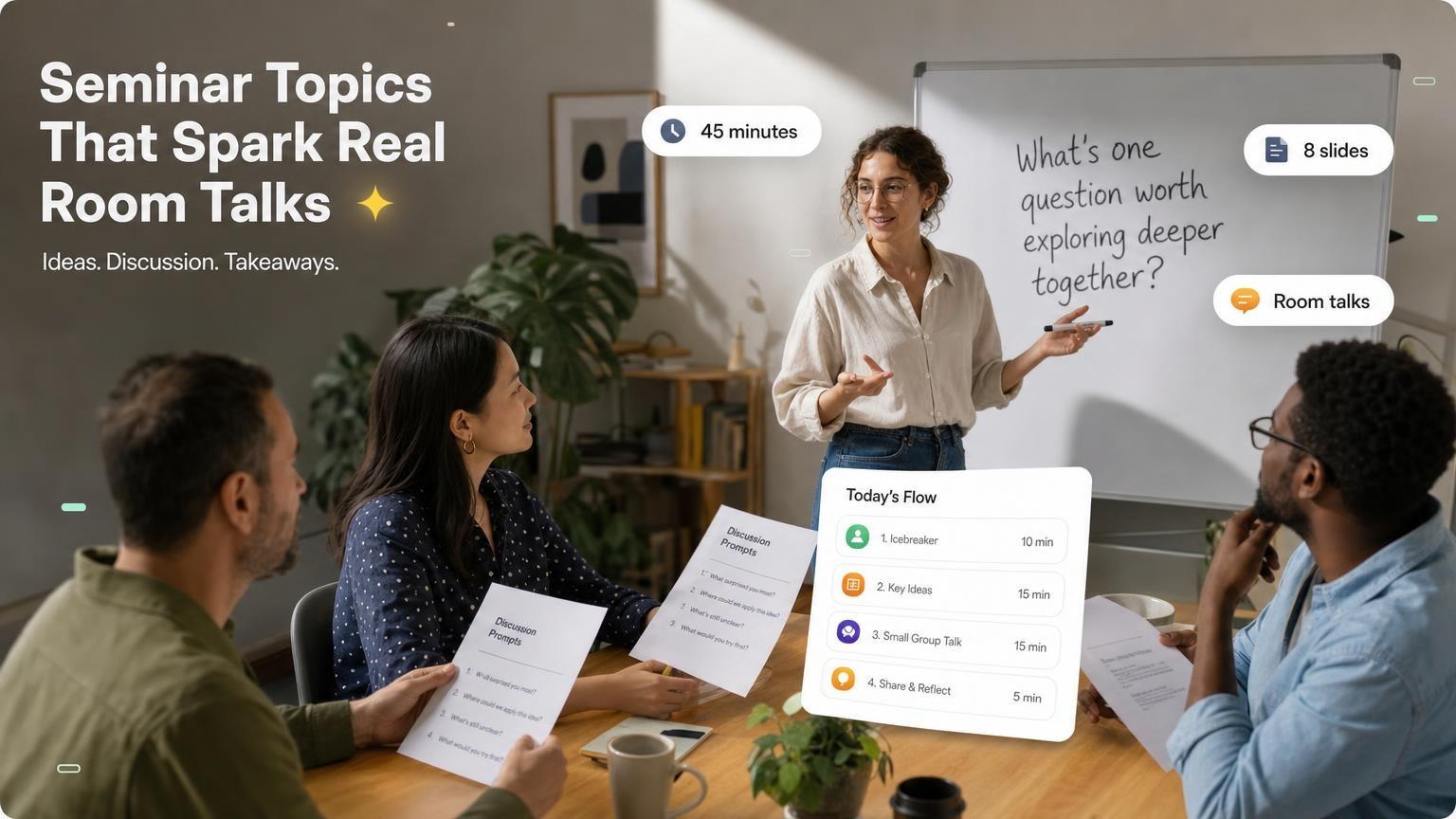
Discussion seminar: 45 minutes
If you talk for 40 minutes and then ask "Any questions?", you taught a lecture. A discussion seminar needs a short text, a clock, and a question with two sides.
| Min | Move |
|---|---|
| 0-3 | Why this question today |
| 3-15 | Input: case, demo, or mini-lecture |
| 15-18 | Silent write (2 minutes) so introverts go first |
| 18-38 | Discussion on 3 prompts |
| 38-45 | Recap: what we still disagree on |
For a shorter slot, use 10-minute presentation topics. For a speech, use informative speech topics or TED talk topics.
Seminar topics for students
These 24 general topics suit a school or first-year seminar. No special background is necessary, and each one fits a 10-minute slot.
Study, skills and career
- Spaced repetition or rereading: which study method holds up?Create
- What a recruiter reads first on a student resumeCreate
- Time blocking for a week with four deadlinesCreate
- How to read a research paper in three passesCreate
- Why group projects fail, and one team contract that helpsCreate
- What an internship teaches that a course does notCreate
Health and daily life
- How sleep loss changes what you remember from a lectureCreate
- How phone notifications break deep workCreate
- A first budget: rent, food, savings and one mistake to skipCreate
- How caffeine works and when it stops helpingCreate
- Exam stress: what helps in the last 48 hoursCreate
- How to spot a health claim that has no evidenceCreate
Technology and society
- How a recommendation feed decides what you seeCreate
- How to check if an image is AI-generatedCreate
- What happens to your data when you accept cookiesCreate
- How online scams target studentsCreate
- Should schools allow AI tools for homework?Create
- How instant mobile payments changed small shopsCreate
Environment
- Where one plastic bottle goes after the binCreate
- The water cost of one cotton T-shirtCreate
- What a campus can do about food wasteCreate
- Electric bus or diesel bus: which costs less over its life?Create
- Why cities are hotter than the land around themCreate
- How rooftop solar pays back for one householdCreate
College seminars
These 40 topics are questions with two sides, written for a discussion seminar. Change "this campus" or "this department" to your own.
Campus policy
- Should this campus ban phones in lectures?Create
- Is a four-year degree still a public good?Create
- Should student government use ranked-choice voting?Create
- Campus police or unarmed responders: who answers which call?Create
- Should legacy admissions end?Create
- Should attendance count toward the grade?Create
- Sports or labs: which gets the next budget dollar?Create
- Should a department carry a donor's name?Create
- Should 8 a.m. classes exist?Create
- Religious holidays and exam week: who moves?Create
- Does tenure still protect unpopular research?Create
- Should mental health days be in the academic calendar?Create
- What should change in Greek life after a lawsuit?Create
Academic honesty, AI and research
- AI citations: what counts as honest work now?Create
- Who should pay for open access papers?Create
- Is grade inflation a problem this department should fix?Create
- Should student research on people need ethics board review?Create
- Who owns a student's notes when AI wrote them?Create
- Fieldwork ethics in 2026: consent, photos and dataCreate
- Should students see the peer review of the papers they read?Create
- Is cheating sometimes a sign of a bad assignment?Create
- Should edtech companies be allowed to sell student data?Create
- What is the carbon cost of one research lab?Create
- Is required group work fair?Create
Curriculum and culture
- Lecture or seminar: which should this department use more?Create
- Whom does the canon still exclude?Create
- Does translation count as scholarship?Create
- What does "employability" do to a major?Create
- Can a library without books still be a library?Create
- Should Shakespeare stay a required text?Create
- What is the last book that every student here read?Create
- How does this city show up in our syllabus?Create
- What can a "safe space" mean, and what can it not mean?Create
Fairness, protest and the town
- Unpaid internships: who can afford to take them?Create
- Should a climate protest be allowed to block a road?Create
- Campus protest: which time, place and manner rules are fair?Create
- Who works in the dining hall, and on what terms?Create
- Is study abroad a form of extraction?Create
- Disability accommodations: design them in or grant exceptions?Create
- What does this college owe the town it sits in?Create
If you present alone and there is no discussion, a narrower list helps: see college presentation topics sorted by subject and by length.
Work seminars
These 40 topics suit a team seminar, a lunch-and-learn, or an offsite session. Each one is a question that the team can argue about with its own numbers.
People and pay
- Four-day week: which teams get left out?Create
- Return to office: policy or power move?Create
- On-call and sleep: what is a safe rota?Create
- Should this team share its pay bands?Create
- Do our hiring loops filter for polish and not for skill?Create
- Are interns here to learn or to be cheap labor?Create
- After-hours messages: what should the rule be?Create
- After a layoff: what do the people who remain need?Create
- Should pay depend on where you live?Create
- What does "owner" mean when it is not in the bonus?Create
- Manager training that is not a video: what would it be?Create
- When is a "refresh" really a reorg?Create
- A meeting load audit: which meetings should end?Create
Product and engineering
- When should we kill a product?Create
- When is customer research only sales in disguise?Create
- Should an accessibility fault block a launch?Create
- The vendor we cannot fire: how did we get here?Create
- Written docs or tribal knowledge: what does this team run on?Create
- How do you run a postmortem with no villain?Create
- Which of our metrics harm the work?Create
- Who is allowed to say the roadmap is wrong?Create
- What happens when sales promises what engineering cannot build?Create
- How do you give design critique without humiliation?Create
- Could intern demo day be run as a seminar?Create
- Is customer support a part of the product?Create
- Which tool did we buy for status and not for work?Create
- Why do the board slides and the team's numbers differ?Create
- How should we talk about competitors?Create
Ethics, data and risk
- AI on this team: what should the written rule say?Create
- Do we owe money to the open source we use?Create
- If we shipped user content, who would moderate it?Create
- Do our climate claims match what the factory does?Create
- Security theater or real risk: where do we spend?Create
- Which data should we never train a model on?Create
- Whom does our brand voice exclude?Create
- How would whistleblowing work inside this company?Create
- Privacy or growth: which experiments should we refuse?Create
- An ethics case from last quarter, in 45 minutesCreate
- Why is our legal PDF unreadable, and who can fix it?Create
- What will this team never automate?Create
Two of these topics end in a slide for leadership. For board slides, see pitch deck structure. For the competitor topic, see the competitor analysis slide.
Seminar topics for management and MBA students
A management seminar works best when it is built on one company, one decision, or one dataset. Each row gives a topic and one angle that fits a 15 to 20 minute slot.
| Topic | Narrow it to | Create |
|---|---|---|
| Dynamic pricing and customer trust | One brand's price change and how customers reacted | Create → |
| Unit economics of fast delivery | The cost of one order, line by line | Create → |
| AI agents in customer service | Which tickets to automate and which to keep human | Create → |
| ESG reporting and greenwashing | One company's claims against its reported emissions | Create → |
| The four-day work week | What trial results measure and what they leave out | Create → |
| Direct-to-consumer brands | Why the cost to win a customer rises as a brand grows | Create → |
| Supply chain resilience | Single source or dual source for one critical part | Create → |
| Behavioral economics in pricing | Decoy and anchor prices on one pricing page | Create → |
| Creator-led marketing | How to measure sales from one creator campaign | Create → |
| Subscription fatigue | Why customers cancel, and what a save offer costs | Create → |
| Family business succession | One handover that worked and one that failed | Create → |
| Buy now, pay later | Who carries the risk when a shopper pays late | Create → |
| Managing hybrid teams | One rule set for meetings, documents and response times | Create → |
| Startup valuation methods | Value one early-stage company three ways | Create → |
Prep the night before
- One page: question, 3 quotes or numbers, 3 prompts
- 8 slides max for a discussion seminar, 28pt+ type (design tips)
- A silent-write prompt on paper or a shared doc
- A timer someone else holds
If discussion dies, ask "Who disagrees with the last speaker?" Do not ask "Any thoughts?"
For a technical seminar, also prepare an answer to three questions that a panel often asks:
- What is the main limitation?
- What does it cost, or how does it scale?
- What comes next in this field?
STEM / technical seminars (questions, not glossaries)
A technical discussion seminar starts from a decision that the team must make, not from a definition. These 12 questions come from real engineering trade-offs.
- Should we ship RAG that cannot cite a page?Create
- Is multi-cloud a reliability strategy or a resume line?Create
- Should on-call be illegal after 12 hours awake?Create
- Do model evals that ignore support tickets count?Create
- Should we log prompts that contain customer PII?Create
- Is "move fast" compatible with accessibility as a launch blocker?Create
- Should intern code ship without a named reviewer?Create
- Is open source we consume but never fund theft?Create
- Should feature flags stay in prod forever?Create
- Can we fire a vendor whose security questionnaire is theater?Create
- Should exec dashboards use a different number than engineering?Create
- Is a postmortem without a name still honest?Create
For demo talks rather than seminars, use technical presentation topics. For a technical seminar that you present to a class or a panel, use the lists by field below.
Technical seminar topics for computer science (CSE)
These 16 topics are current in computer science and software engineering. The second column gives one angle that you can explain with a diagram in 15 to 20 minutes.
| Topic | Narrow it to | Create |
|---|---|---|
| Agentic AI and multi-agent systems | How one agent plans, calls a tool and checks the result | Create → |
| Retrieval-augmented generation (RAG) | Why a RAG answer can cite the wrong passage | Create → |
| Post-quantum cryptography | What changes in one TLS handshake | Create → |
| Zero trust architecture | One login request, traced through each check | Create → |
| Passkeys and passwordless sign-in | Why a passkey resists phishing | Create → |
| Software supply chain security | How one poisoned dependency reaches production | Create → |
| Confidential computing | What a trusted execution environment protects, and what it does not | Create → |
| Differential privacy | How added noise protects one person in a dataset | Create → |
| Federated learning | Train one model across many phones with no raw data shared | Create → |
| Vector databases | How nearest-neighbor search trades accuracy for speed | Create → |
| WebAssembly outside the browser | One workload where Wasm replaces a container | Create → |
| eBPF for observability | Trace one slow request inside the Linux kernel | Create → |
| Edge computing | Which part of one app should run near the user | Create → |
| Rust and memory safety | One class of bug that the compiler refuses | Create → |
| Carbon-aware computing | Move one batch job to a low-carbon hour | Create → |
| Quantum computing basics | What a qubit is, and one algorithm that uses it | Create → |
Seminar topics on artificial intelligence
"What is AI" is too broad for one session. Each of these 14 topics names one part of the field and one angle that you can show with an example.
| Topic | Narrow it to | Create |
|---|---|---|
| Small language models on a phone | What you gain and lose against a cloud model | Create → |
| AI hallucination | Why a model states a false fact, and three ways to reduce it | Create → |
| Prompt injection | How a web page can hijack an AI agent, and the current defenses | Create → |
| Explainable AI (XAI) | Explain one loan decision to the person who was refused | Create → |
| Deepfake detection | Which signals still work on new video models | Create → |
| AI in medical imaging | One task where a model helps a radiologist, and one where it fails | Create → |
| Multimodal models | How one model reads text, images and audio | Create → |
| AI coding assistants | What changes in code review when a model writes the first draft | Create → |
| Model evaluation and benchmarks | Why a high benchmark score can still fail your users | Create → |
| AI regulation | What the EU AI Act asks of a high-risk system | Create → |
| Bias and fairness in machine learning | Measure bias in one hiring dataset | Create → |
| Reinforcement learning | How an agent learns one game from reward alone | Create → |
| Energy use of AI | Training or inference: where the electricity goes | Create → |
| Synthetic data | When generated data helps training and when it harms | Create → |
Seminar topics for engineering students
These 32 topics cover four branches. Choose from your own branch, or choose a topic that crosses two branches, such as digital twins or batteries.
Electronics and communication (ECE)
| Topic | Narrow it to | Create |
|---|---|---|
| 6G and terahertz communication | Why a higher frequency means a shorter range | Create → |
| RISC-V processors | How an open instruction set changes who can design a chip | Create → |
| Chiplets and 3D packaging | Why one large chip becomes several small ones | Create → |
| TinyML | Run a keyword detector on a microcontroller | Create → |
| Direct-to-device satellite links | How an ordinary phone reaches a satellite | Create → |
| Automotive radar and LiDAR | What each sensor sees in rain and fog | Create → |
| Neuromorphic chips | How a spiking neuron differs from a logic gate | Create → |
| 5G network slicing | One network, three service levels | Create → |
Electrical and electronics (EEE)
| Topic | Narrow it to | Create |
|---|---|---|
| Smart grids | How a grid balances solar output at noon | Create → |
| Vehicle-to-grid (V2G) | When a parked car sells power back | Create → |
| Solid-state batteries | What blocks mass production | Create → |
| Green hydrogen electrolyzers | Alkaline or PEM: cost and efficiency | Create → |
| Microgrids | How a campus keeps power in a blackout | Create → |
| HVDC transmission | Why direct current suits long distances | Create → |
| Wireless EV charging | The efficiency loss across an air gap | Create → |
| Floating solar plants | What water does to panel output and upkeep | Create → |
Mechanical engineering
| Topic | Narrow it to | Create |
|---|---|---|
| Metal additive manufacturing | One part that is cheaper to print than to machine | Create → |
| EV thermal management | How a battery pack stays in its safe temperature range | Create → |
| Hydrogen engines and fuel cells | Two ways to use the same fuel | Create → |
| Collaborative robots (cobots) | What makes a robot safe beside a person | Create → |
| Digital twins in manufacturing | One machine and its live model | Create → |
| Generative design | How software removes material that a part does not need | Create → |
| Predictive maintenance | Predict one bearing failure from vibration data | Create → |
| Composite materials in vehicles | Where carbon fiber saves weight and where it fails | Create → |
Civil engineering
| Topic | Narrow it to | Create |
|---|---|---|
| 3D-printed buildings | What a printer can and cannot build today | Create → |
| Self-healing concrete | How bacteria seal a crack | Create → |
| BIM and digital twins | One building, from model to maintenance | Create → |
| Net-zero energy buildings | The energy balance of one building over a year | Create → |
| Low-carbon concrete | Geopolymer and other cement substitutes | Create → |
| Earthquake-resistant design | Base isolation, explained with one building | Create → |
| Modular construction | What moves to the factory and what stays on site | Create → |
| Sponge cities | How one street absorbs a heavy rain | Create → |
Science seminar topics
These 12 topics suit a physics, chemistry, biology or environmental science seminar. Each angle points to one mechanism or one method.
| Topic | Narrow it to | Create |
|---|---|---|
| CRISPR base editing | How base editing differs from cutting DNA | Create → |
| mRNA beyond vaccines | How an mRNA therapy tells a cell what to make | Create → |
| Microplastics | Where they come from and how a lab measures them | Create → |
| Perovskite solar cells | High efficiency in the lab, short life outdoors: why | Create → |
| Gravitational waves | How a detector measures a very small change in length | Create → |
| Carbon capture | Capture from the air or capture at the chimney | Create → |
| Antibiotic resistance | How one resistance gene moves between bacteria | Create → |
| The gut microbiome | What current studies can and cannot show | Create → |
| Fusion energy | What "net energy gain" means and what it leaves out | Create → |
| Green chemistry | Replace one toxic solvent in a common reaction | Create → |
| Exoplanet atmospheres | How a telescope reads the air of a distant planet | Create → |
| Battery recycling | How lithium is recovered from a used cell | Create → |
Medical, nursing and pharmacy seminar topics
A clinical seminar is strongest when it starts from one patient, one rule, or one study. Check each clinical claim against a current guideline before you present it.
| Topic | Narrow it to | Create |
|---|---|---|
| Antimicrobial stewardship | One hospital prescribing rule and why it exists | Create → |
| GLP-1 medicines | How they act, and which long-term data is still missing | Create → |
| AI in radiology | Where a model helps a radiologist and where it fails | Create → |
| Telemedicine | Which visits work on video and which do not | Create → |
| Pharmacogenomics | One gene that changes the dose of one drug | Create → |
| Pharmacovigilance | How one side-effect report becomes a safety warning | Create → |
| Polypharmacy in older adults | A medicine review for one patient on many medicines | Create → |
| CAR-T cell therapy | How a patient's own cells are changed to attack a cancer | Create → |
| Nurse staffing and patient safety | What the evidence measures and what it does not | Create → |
| Continuous glucose monitors | What changes for one patient with diabetes | Create → |
| Burnout in health workers | Causes at the system level and one change that helps | Create → |
| Palliative care | When to start the conversation with a patient | Create → |
| Vaccine hesitancy | How to answer three common concerns | Create → |
| Hand hygiene and hospital infections | Why compliance drops and what raises it | Create → |
Seminar topics for education and teachers
These 10 topics suit an education course, a teacher training day, or a staff seminar. Each one is a classroom decision that the room can argue from experience.
- How to grade fairly when students use AI toolsCreate
- Does homework help learning in primary school?Create
- Formative or summative assessment: which should a teacher change first?Create
- Flipped classroom: what moves home and what stays in classCreate
- How to teach one lesson to a class with mixed ability levelsCreate
- What makes written feedback useful to a studentCreate
- Project-based learning: how to grade one team fairlyCreate
- Game-based learning: where it helps and where it distractsCreate
- How to plan one lesson with universal design for learningCreate
- Teacher burnout: causes at the school level and one change that helpsCreate
Seminar slide outline (10 slides)
This outline fits a 15-minute technical seminar. Copy it, then replace each line with your own content.
1. Title: the question, your name, the date
2. Why now: one fact, with its source
3. Background: the two terms the audience needs
4. How it works: one diagram
5. Example: one real system, study or company
6. Result: one number or chart, with its source
7. Limits: what does not work yet
8. What comes next: open problems
9. Summary: three sentences
10. References and questions
GenPPT can draft this deck from your topic. You start from a prompt, a PDF, a Word document, a text file, images or a link. GenPPT researches the topic and drafts an outline that you approve.
You then pick a visual concept. Generation takes about 2 to 3 minutes after you approve the outline. You edit slides in chat and export to PowerPoint (.pptx) or PDF.
There are two limits. The slides are image-native designs, so charts do not link to Excel. And you must check each number and claim yourself, because the panel will ask for the source.
The trial costs $1 for 3 days of full access, and a card is required. After the trial, the price is $25 per month or $99 per year, with 20 decks per month. There is no free plan.
Full session pack: AI on homework
This is one complete discussion seminar, ready to run in 45 minutes.
- Question. Should this campus allow AI on take-home work with disclosure?
- Assigned text. The course honor code (2 pages) plus one news brief on a detection-tool failure.
- Silent write. "What would you want disclosed if you were grading?"
- Prompts. (1) Equity of paid models. (2) What "authorship" means. (3) What stays a seated exam.
- 8 slides. Question, two quotes from the text, three prompts, unresolved list, next week's reading.
- One-pager. Question / 3 quotes / 3 prompts. Print it.
FAQ
What is a good seminar topic?
A good seminar topic is one narrow question that fits your slot, has two or three solid sources, and leaves something to discuss. "Blockchain" is a subject. "Can a blockchain track food from farm to shelf?" is a topic.
How do I choose a seminar topic?
List three topics from your field that interest you. For each one, write the topic sentence from the template above and look for two sources. Keep the topic where the sentence is easy to write and the sources exist, then get approval from your guide or instructor before you make slides.
What are the best seminar topics for college students?
Topics that affect the students in the room work best: phones in lectures, AI on take-home work, unpaid internships, open access papers, and attendance rules. Each one has a clear question and two sides. See the 40 college seminar topics above.
What are the best technical seminar topics?
Choose a current topic with a mechanism that you can draw. Strong picks in 2026 include agentic AI, retrieval-augmented generation, post-quantum cryptography, passkeys, RISC-V, solid-state batteries, digital twins and low-carbon concrete. Do not present "What is AI". It is too broad for one session.
What are the latest seminar topics for 2026?
In computing: agentic AI, small language models, prompt injection and post-quantum cryptography. In engineering: solid-state batteries, green hydrogen, chiplets and direct-to-device satellite links. In medicine: GLP-1 medicines and AI in radiology. The latest topics table has 16 picks with a Create link for each.
How long should a seminar be, and how many slides do I need?
Use the slot that your department gives you. For a talk that you present, plan about one slide for each minute you speak and keep about a quarter of the slot for questions. That gives 10 to 12 slides for a 15-minute slot. For a 45-minute discussion seminar, talk for 12 to 15 minutes and use 8 slides at most.
What is the difference between a seminar, a lecture and a presentation?
In a lecture, you talk and the room listens. In a presentation, you explain or persuade, then take questions. In a seminar, the room does part of the work: it reads a short text first, then discusses your prompts. Many engineering colleges also use "seminar" for a short technical talk by one student, followed by questions from a panel.