
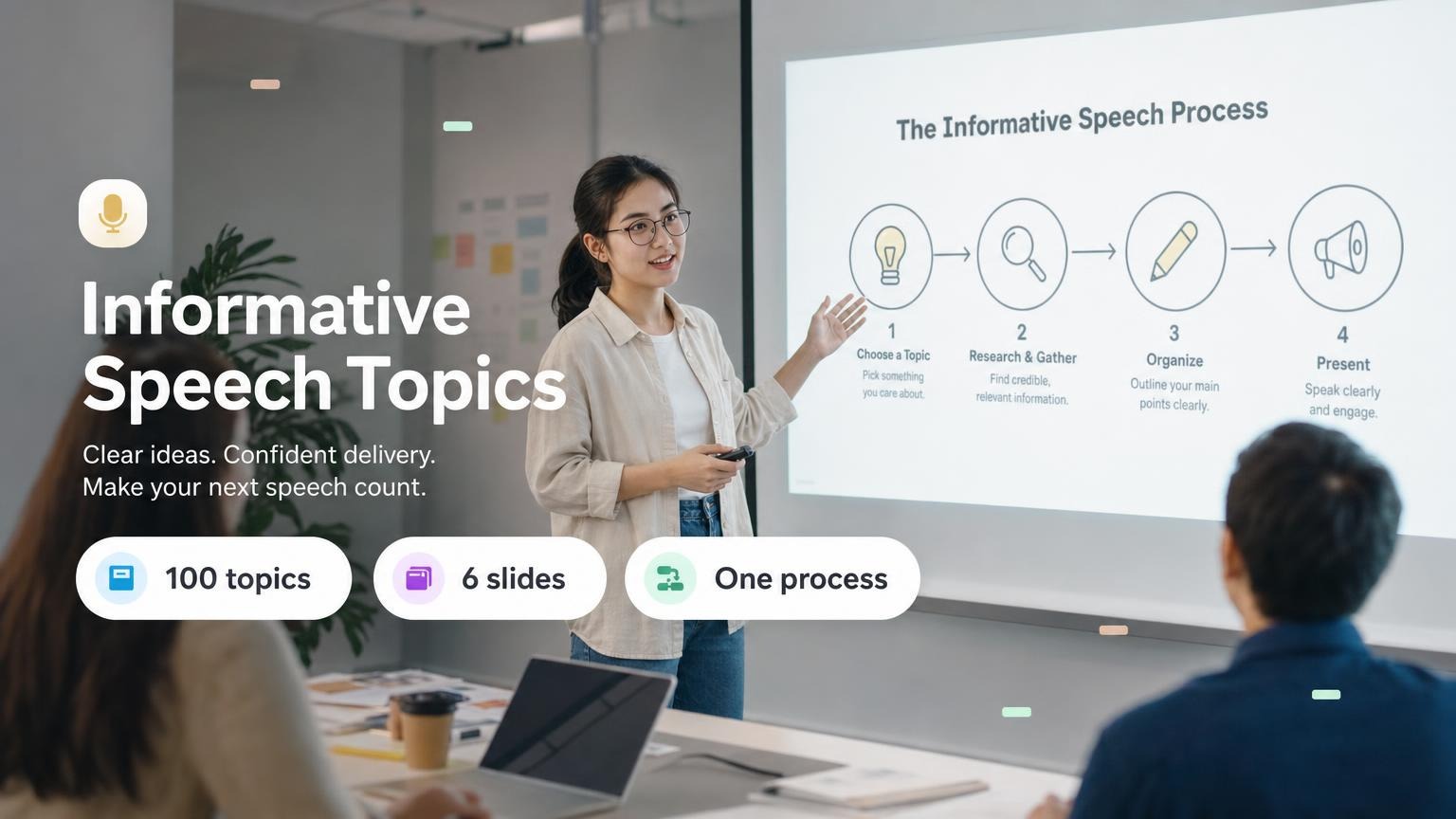
A good informative speech topic is one process, object, event, or idea that you can explain in your time slot without telling the audience what to do. The strongest topics answer a "how" or "why" question, such as how noise-cancelling headphones cancel sound.
This page lists 250+ informative speech topics in 13 groups: 10 good starter topics, then easy, fun, college, high school, 5-minute, and seven subject lists. It also gives you a 4-step way to pick a topic and an outline template you can copy.
Tap Create next to a topic to start a deck on it in GenPPT.
Good informative speech topics
A good topic passes three tests: it fits your time slot, you can show it in one diagram, and you can name a primary source for it. These 10 topics pass all three.
Start here if you are short on time. The longer lists by level, time, and subject follow.
- How airplanes stay in the airCreate
- How hurricanes get their namesCreate
- How coffee is decaffeinatedCreate
- How a jury is selectedCreate
- How inflation is measuredCreate
- How glasses correct your visionCreate
- How a tattoo stays in the skinCreate
- How the Electoral College picks a presidentCreate
- What scientists know about why we dreamCreate
- How a polygraph works and why courts doubt itCreate
What is an informative speech?
An informative speech teaches the audience about one subject. The goal is that they understand it and remember it.
An informative speech is not a persuasive speech in disguise. You are not closing a sale. You are making one process, object, or event understandable.
Most public speaking courses sort informative speeches into four types. Your topic decides the type, and the type decides how you organize the talk.
| Type | What you explain | Example topic |
|---|---|---|
| Object | A thing, person, place, or animal | What microplastics are and where they show up |
| Process | How something works or is done | How city recycling actually gets sorted |
| Event | Something that happened or happens | How time zones were a railroad problem |
| Concept | An idea, a theory, or a term | What "herd immunity" does and does not mean |
Process topics are the easiest to plan. The steps give you the structure.
Informative vs persuasive speech
| Informative | Persuasive | |
|---|---|---|
| Goal | The audience understands | The audience agrees or acts |
| Thesis | "Here is how X works" | "We should do X" |
| Evidence | Facts, steps, examples | Facts plus answers to the other side |
| Test | No "should" in the thesis | A reasonable person can disagree |
How to pick
Ask: can I teach this without arguing that people should do something? If you keep slipping into "should," it is persuasive. Try debate topics instead.
Use these four steps:
- Read the assignment. Write down the time limit, the number of sources, and the rules for visual aids.
- List what you already know. Your job, your major, a sport, a hobby, your city. You explain a subject better when you have used it.
- Turn the subject into a question. Start with "how," "why," or "what." "Recycling" becomes "How city recycling actually gets sorted."
- Run the tests below. If the topic fails two of them, pick another one.
Good tests:
- I can demo it or show one diagram
- I can name a misconception in one sentence
- I can find a number from a real agency or paper
Narrow a broad subject
A broad subject is not a topic. Pick a slice: how it works, how it changed, or what a beginner gets wrong.
| Broad subject | Topic that fits 5 to 6 minutes |
|---|---|
| Climate change | How a heat pump moves heat |
| Vaccines | How mRNA vaccines teach cells |
| Money | What a credit score is made of |
| Social media | How social media algorithms pick your feed |
| The Olympics | How Olympic judges score gymnastics |
Match the topic to the clock
Plan about one slide per minute. A shorter slot needs a smaller topic, not faster speech.
| Time slot | Main points | Slides | Topic size |
|---|---|---|---|
| 2 minutes | 1 | 0 to 3 | One fact or one step |
| 5 minutes | 2 to 3 | 5 to 6 | One process, start to finish |
| 10 minutes | 3 | 8 to 10 | A process plus its history or a comparison |
Already have a topic? Start the deck now and come back for the outline.
Easy informative speech topics
These topics are easy because your audience already uses the thing you explain. You can research each one in an evening, and each has an obvious diagram.
- How a microwave oven heats foodCreate
- How caffeine keeps you awakeCreate
- How a touchscreen senses your fingerCreate
- Why leaves change color in the fallCreate
- How the Dewey Decimal System sorts a libraryCreate
- Why the sky is blueCreate
- How bees make honeyCreate
- How a zipper worksCreate
- How popcorn popsCreate
- Why onions make you cryCreate
- How a refrigerator keeps food coldCreate
- What the numbers inside a recycling symbol meanCreate
- How compound interest grows a savings accountCreate
- How sunscreen blocks UV lightCreate
- What a calorie measuresCreate
- How a rainbow formsCreate
- How soap removes greaseCreate
- How to read a nutrition facts labelCreate
- How weather forecasters predict rainCreate
- How to change a flat tireCreate
Fun informative speech topics
A fun topic takes a small, odd question and answers it with real sources. The humor comes from the facts. The speech still has to teach something.
- Why cats purrCreate
- How LEGO keeps bricks compatible across decadesCreate
- Why songs get stuck in your headCreate
- Where emoji came fromCreate
- How a roller coaster stays on the trackCreate
- How Foley artists make movie sound effectsCreate
- Why you get brain freezeCreate
- How a crossword puzzle is builtCreate
- Why flamingos are pinkCreate
- How speedrunners finish a video game in minutesCreate
- Why golf balls have dimplesCreate
- How a magician uses misdirectionCreate
- Why the QWERTY keyboard is laid out that wayCreate
- How bubble wrap started as wallpaperCreate
- Why the Tower of Pisa leansCreate
- How Monopoly began as a game about landlordsCreate
- Why wombat droppings are cube-shapedCreate
- How Hawaiian pizza was invented in CanadaCreate
- Where the word "OK" came fromCreate
- Where unclaimed airline luggage ends upCreate
Informative speech topics for college students
College instructors look for a narrow thesis and cited sources. These topics come from campus life, money, and research, so you have experience to add to the facts.
- How the FAFSA calculates your Student Aid IndexCreate
- How interest builds on an unsubsidized student loanCreate
- What a credit hour measuresCreate
- How a college gets accreditedCreate
- How college rankings are calculatedCreate
- How a university endowment is spentCreate
- How Federal Work-Study jobs are fundedCreate
- How study abroad credits transferCreate
- How tenure works for professorsCreate
- How peer review works at a journalCreate
- How plagiarism checkers compare your paper to a databaseCreate
- How AI text detectors work and why they flag human writingCreate
- How large language models predict the next wordCreate
- How spaced repetition improves memoryCreate
- What sleep loss does to memory the next dayCreate
- How applicant tracking software screens a resumeCreate
- How a credit card grace period worksCreate
- How a security deposit works in a leaseCreate
- How a Roth IRA differs from a traditional IRACreate
- What Title IX coversCreate
If the assignment is a class presentation and not a speech, see unique college presentation topics.
Informative speech topics for high school students
These topics connect to classes you take and things you do each day. Each one has a clear answer you can find in a textbook or on an agency website.
- How the digital SAT adapts to your answersCreate
- How an AP exam is scoredCreate
- How a driver's license point system worksCreate
- How social media algorithms pick your feedCreate
- How a streaming service recommends showsCreate
- How a search engine ranks pagesCreate
- How deepfakes are made and spottedCreate
- How video games get their age ratingsCreate
- How esports teams earn moneyCreate
- How a bill becomes a lawCreate
- How the Supreme Court picks its casesCreate
- How minimum wage is set in your stateCreate
- How a school budget is decidedCreate
- How photosynthesis turns light into sugarCreate
- How the periodic table is organizedCreate
- How earthquakes are measuredCreate
- How a tornado formsCreate
- How the immune system remembers a virusCreate
5-minute informative speech topics
A 5-minute slot holds two or three main points. These topics have one mechanism to explain, so they fit without a rush.
- How a barcode is readCreate
- Why we have leap yearsCreate
- How a traffic light knows a car is waitingCreate
- How fireflies glowCreate
- How a compass finds northCreate
- How a smoke detector senses smokeCreate
- Why the ocean is saltyCreate
- How tides follow the moonCreate
- How a thermos keeps drinks hotCreate
- What the SPF number meansCreate
- How a ZIP code routes a letterCreate
- How hand sanitizer kills germsCreate
- How a credit card chip worksCreate
- How a seat belt locks in a crashCreate
For a shorter slot, use these 2-minute speech topics. For a longer one, use these 10-minute presentation topics.
School and everyday
Use these for a general class audience. No background knowledge is necessary.
- How noise-cancelling headphones cancel soundCreate
- Why school start times fight teen circadian rhythmsCreate
- How a library decides what to buyCreate
- What a credit score is made ofCreate
- How city recycling actually gets sortedCreate
- Why airplanes dim lights for landingCreate
- How closed captions are madeCreate
- What "organic" on a label legally means in the USCreate
- How a 3D printer lays a partCreate
- Why daylight saving time existsCreate
- How QR codes store dataCreate
- What happens in the first 24 hours of a hurricane warningCreate
- How public radio is fundedCreate
- Why bread goes staleCreate
- How a bike lock is picked (and how to choose one)Create
- What a national park ranger's week looks likeCreate
- How subtitles differ from captionsCreate
- Why your phone battery dies in the coldCreate
- How a voting machine is tested before election dayCreate
- What a food recall actually triggers in a warehouseCreate
- How noise maps are made for citiesCreate
- How a train switches tracksCreate
- How a dictionary decides to add a new wordCreate
- What "fair use" covers for a student videoCreate
- How a yearbook is printedCreate
Science and health
Each of these has a primary source: an agency page, a journal paper, or a textbook chapter. Start there, not with a blog.
- How mRNA vaccines teach cellsCreate
- What a clinical trial phase actually testsCreate
- How insulin was discovered, in three beatsCreate
- Why we still use Fahrenheit in the USCreate
- Why a pulse oximeter can be less accurate on darker skinCreate
- What microplastics are and where they show upCreate
- How CRISPR cuts DNA, without the hype slideCreate
- Why concussion protocols changed in the last decadeCreate
- How a heat pump moves heatCreate
- What "herd immunity" does and does not meanCreate
- How GPS satellites keep timeCreate
- Why antibiotics do not treat virusesCreate
- How a cochlear implant turns sound into signalsCreate
- What a carbon offset buys, in practiceCreate
- How blood types were foundCreate
- Why the moon looks larger on the horizonCreate
- How a PCR test amplifies DNACreate
- What PFAS are doing in water systemsCreate
- How sleep stages cycleCreate
- Why iodine is in table saltCreate
- How a fusion experiment measures energy gainCreate
- What a placebo-controlled trial controls forCreate
- How forest fire smoke travelsCreate
- Why bees danceCreate
- How a pacemaker is implanted, at a high levelCreate
Technology informative speech topics
Technology topics work when you explain one mechanism. Skip "the future of AI." Explain how one thing works today.
- How end-to-end encryption protects a messageCreate
- How a password manager stores your passwordsCreate
- How two-factor authentication stops a stolen passwordCreate
- How a self-driving car sees the roadCreate
- How a data center is cooledCreate
- How contactless payment worksCreate
- How a lithium-ion battery stores energyCreate
- How a phone camera takes a night photoCreate
- How undersea cables carry the internetCreate
- How a chatbot is trainedCreate
- How facial recognition matches a faceCreate
- How a blockchain records a transactionCreate
- How streaming video adapts to a slow connectionCreate
- What a browser cookie storesCreate
- How regenerative braking charges an electric carCreate
- How Bluetooth pairs two devicesCreate
Psychology informative speech topics
Psychology topics are popular because the audience can test them on themselves. Cite the study, not a summary of the study.
- How habits formCreate
- Why we procrastinateCreate
- How the placebo effect worksCreate
- What the bystander effect is, and what newer studies foundCreate
- How confirmation bias shapes what we readCreate
- What researchers think causes déjà vuCreate
- How memory changes each time you recall itCreate
- Why multitasking slows you downCreate
- How stage fright affects the bodyCreate
- How first impressions formCreate
- How sleep helps the brain store memoriesCreate
- What the Dunning-Kruger effect does and does not showCreate
- How anchoring changes what price seems fairCreate
- How the fight-or-flight response worksCreate
Work, money, and civic
Use these for a business class, a team meeting, or a civics assignment. Many of them change by state, so use your own state's rules as the example.
- How an ACH transfer moves overnightCreate
- What a 401(k) match actually costs the companyCreate
- How a FOIA request worksCreate
- What "at-will employment" means in your stateCreate
- How a term sheet is not a checkCreate
- What SOC 2 is (and is not)Create
- How congestion pricing cameras workCreate
- What an ETF holdsCreate
- How a union ratification vote is runCreate
- What a municipal bond fundsCreate
- How unemployment insurance is calculated, roughlyCreate
- What an NDA can and cannot coverCreate
- How a medical device gets FDA 510(k) clearanceCreate
- How open source license families differCreate
- How a newsroom decides a correctionCreate
- What a carbon border tariff tries to doCreate
- How payroll withholding is splitCreate
- What a zoning variance hearing isCreate
- How an RFP is scoredCreate
- What "accredited investor" meansCreate
- How a copyright small-claims case worksCreate
- What a stock split does to your sharesCreate
- How 911 call centers triageCreate
- What a data retention policy is forCreate
- How a company does a tabletop security drillCreate
- What redlining maps still explainCreate
- How a recall election is triggeredCreate
- What "net neutrality" fights were aboutCreate
- How a wind farm gets connected to the gridCreate
- What a livable wage calculation includesCreate
- How a patent expires and what happens nextCreate
- What a clawback in exec pay isCreate
- How ranked-choice ballots are countedCreate
- What a fiscal year is vs a calendar yearCreate
- How a nonprofit's Form 990 is readCreate
- What "conflict minerals" reporting coversCreate
- How a city sets a speed camera fineCreate
- What a reverse mortgage does to the houseCreate
- How an index fund stays cheapCreate
- What "chain of custody" means in evidenceCreate
- How a public comment period worksCreate
- What a 1099 vs W-2 changes for the workerCreate
- How a tariff changes the cost of a toaster's partsCreate
- What an environmental impact statement containsCreate
- How a board's audit committee is supposed to workCreate
- What "fair lending" exams look forCreate
- How a domain name is registeredCreate
- What a kill fee in journalism isCreate
- How a city compost program is pricedCreate
- What a slide deck is for in a status meetingCreate
Arts, sports, and entertainment topics
Rules, scores, and money make good informative speeches. The audience watches the result every week and does not know how it is decided.
- How a movie gets its ratingCreate
- How a song earns royalties on a streaming serviceCreate
- How the Oscars count Best Picture votesCreate
- How a stop-motion film is shotCreate
- How a museum authenticates a paintingCreate
- How a vinyl record stores soundCreate
- How Auto-Tune corrects pitchCreate
- How a podcast makes moneyCreate
- How instant replay review works in the NFLCreate
- How the NFL draft order is setCreate
- How the offside rule works in soccerCreate
- How the NBA salary cap worksCreate
- How Olympic judges score gymnasticsCreate
- How a marathon course is measuredCreate
6-slide outline
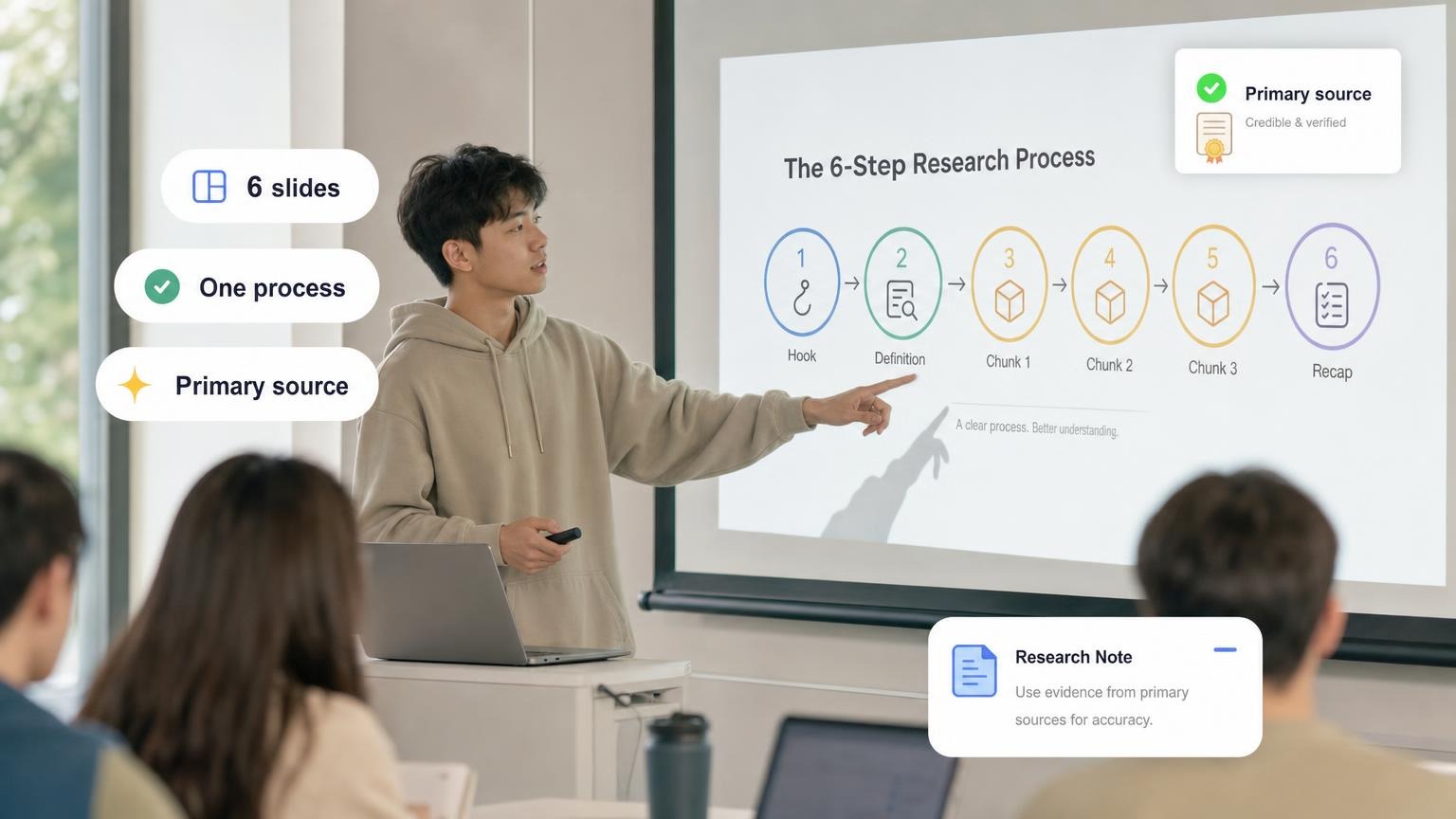
- Hook with a wrong common belief
- Definition in one sentence
- Chunk A (how it works)
- Chunk B (who is involved / a number)
- Chunk C (what people mix up)
- Recap in three bullets they can photograph
Put one idea on each slide. The table shows what the audience sees while you speak.
| Slide | What you say | What you show |
|---|---|---|
| 1. Hook | The belief, then "that is wrong" | One sentence or one photo |
| 2. Definition | The term in one sentence | The term and the definition |
| 3. Chunk A | The steps, in order | One diagram |
| 4. Chunk B | One number and where it comes from | The number, large, with a source |
| 5. Chunk C | The mix-up and the correction | Two columns: myth and fact |
| 6. Recap | The three points again | Three short bullets |
Time it with how many slides per minute. For a short slot, see 2-minute speech topics. For 10 minutes, 10-minute presentation topics.
Informative speech outline template
Many instructors ask for a written outline before you speak. Copy this template and fill in each line. One full sentence per line is sufficient.
Title:
General purpose: To inform
Specific purpose: To inform my audience about ...
Thesis (central idea): ...

INTRODUCTION
1. Attention getter (a wrong common belief, a question, a short story):
2. Why this matters to this audience:
3. Why you can speak on it (experience or research):
4. Thesis and preview of the three main points:

BODY
I. Main point 1 (how it works):
   A. Fact, with source:
   B. Example:
   Transition to point 2:
II. Main point 2 (who is involved, or a number):
   A. Fact, with source:
   B. Example:
   Transition to point 3:
III. Main point 3 (what people mix up):
   A. Fact, with source:
   B. Example:

CONCLUSION
1. Signal the end ("To recap"):
2. Restate the thesis and the three main points:
3. Closing line that returns to the attention getter:

REFERENCES
1. Primary source:
2. Explainer:
3. Explainer:
Pick an order for the main points
The order of your main points depends on the type of topic.
| Pattern | Use it for | Example topic |
|---|---|---|
| Chronological | Processes, histories, how-to talks | How a PCR test amplifies DNA |
| Spatial | Places and things with parts | How a wind farm gets connected to the grid |
| Topical | Types, parts, or categories | What an ETF holds |
| Cause and effect | Why something happens | Why your phone battery dies in the cold |
When the outline is done, you can paste it into GenPPT or upload it as a Word document or PDF. GenPPT researches the topic, drafts a slide outline that you approve, and designs the slides. You then edit slides in chat and export to PowerPoint (.pptx) or PDF.
The slides are full-slide designs, so charts do not link to Excel. Check each number on the slides against your sources before you present.
Research path
For any topic: one primary source (agency, paper, statute), two explainers, one diagram you can redraw. If you cannot name the primary source, pick another topic.
A primary source is the organization or document that the facts come from:
- A government agency page, such as the FDA, NOAA, or the Bureau of Labor Statistics
- A peer-reviewed paper
- A statute, a standard, or an official rulebook
- The organization's own document, such as an annual report or a manual
A 5-day plan
| Day | Task | Done when |
|---|---|---|
| 1 | Pick the topic. Find the primary source | You can say the thesis in one sentence |
| 2 | Read two explainers. Sketch one diagram | You can explain it to a friend without notes |
| 3 | Fill in the outline template | Each main point has one fact with a source |
| 4 | Build the slides | One slide per chunk, sources in the notes |
| 5 | Rehearse out loud with a timer, two times | You finish a little before the time limit |
Worked example: pulse oximeters and skin tone
- Hook: "The number on the fingertip clip is an estimate. For some patients it is a less accurate one."
- Definition: a pulse oximeter uses light to estimate the oxygen level in your blood without a blood sample.
- Chunk A: how the device compares red and infrared light absorption to estimate SpO2.
- Chunk B: the evidence. A 2020 letter in the New England Journal of Medicine compared pulse oximeter readings with blood tests: Black patients had nearly three times the frequency of undetected low oxygen as White patients. The FDA's February 2021 safety communication lists skin pigmentation, poor circulation, and nail polish among the things that affect accuracy. In January 2025 the FDA published draft guidance that asks manufacturers to test devices on more people across a range of skin tones.
- Chunk C: people mix this up with "the device is racist on purpose." The issue the FDA guidance addresses is testing: how many people are in the studies, and what range of skin tones they have.
- Recap: the reading is an estimate, it can read too high for some patients, and a blood test (arterial blood gas) gives the measured value. Do not rely on the fingertip number alone.
Sources to start: the FDA page on pulse oximeters and one peer-reviewed accuracy study, such as the 2020 NEJM letter. Put the URLs in speaker notes.
History and culture (slice titles)
History topics fail when the title is "the history of X." Each of these is one slice with a start and an end.
- How the printing press changed schoolbooks, not "the history of print"Create
- Why US road signs use that typefaceCreate
- How closed captions started as a decoder boxCreate
- Why we still say "cc" on emailCreate
- How a yearbook was printed in 1998 vs nowCreate
- What a 1950s kitchen radio was actually forCreate
- How time zones were a railroad problemCreate
- Why iodine went into salt in the 1920sCreate
- How a public library decided what to ban, then unbanCreate
- What a newspaper correction looked like before the webCreate
More topic lists
An informative speech is one kind of talk. If your assignment is different, use the list that matches it.
| Your assignment | Use this list |
|---|---|
| Argue one side of a question | Debate topics |
| Share one idea with a personal story | TED talk topics |
| Speak for two minutes | 2-minute speech topics |
| Present for ten minutes with slides | 10-minute presentation topics |
| Present in a college class | Unique college presentation topics |
FAQ
What is a good informative speech topic?
A good informative speech topic is a process, a comparison, or a misconception you can teach without a "should." It fits your time slot, it has one primary source, and you can show it in one diagram. "How QR codes store data" is a topic, and "technology" is a subject. Start with these 10 good informative speech topics.
What are easy informative speech topics?
Easy topics explain things your audience already uses: QR codes, why planes dim lights, how a credit score is built, how recycling is sorted in your city. You can research each one in an evening. See the full list of easy informative speech topics.
What are good informative speech topics for college students?
Pick a slice from your major, your job, or campus life that you can diagram in one slide. Examples: how the FAFSA calculates your Student Aid Index, how peer review works at a journal, and how AI text detectors work. Avoid "everything about climate."
What are fun informative speech topics?
Fun topics answer a small, odd question with real sources. Examples: why flamingos are pink, how bubble wrap started as wallpaper, and why golf balls have dimples. Keep every fact true. The surprise does the work that a joke does.
What are the 4 types of informative speeches?
Many public speaking textbooks list four types by subject: objects, processes, events, and concepts. Other textbooks sort by purpose: definitional, descriptive, explanatory, and demonstration speeches. Use the set your instructor uses.
What is the difference between an informative and a persuasive speech?
An informative speech helps the audience understand a subject. A persuasive speech asks the audience to agree or to act. If you keep saying people should change a law, it is a debate topic.
How do I research an informative speech in a week?
Primary source + two explainers + one diagram. Stop collecting blogs. Then follow the 5-day plan: source, explainers, outline, slides, rehearsal.
Turn your topic into slides
Pick a topic from the lists, or type your own. GenPPT researches it, drafts an outline for you to approve, and designs the slides in about 2 to 3 minutes after you approve the outline.
GenPPT has no free plan. The trial costs $1 for 3 days of full access, and a card is necessary. After the trial, the price is $25 per month or $99 per year for 20 decks per month, with PowerPoint and PDF export without a watermark.
Keep diagrams sparse. One process graphic beats five stock photos of science.