
You have 12 minutes and a partner who will open the PDF on a phone in an Uber.
That is the constraint. A "complete" deck that takes 40 slides to explain the TAM is a memo wearing a costume. Structure is how you survive the skim.
Pitch.com's structure post lists six buckets: mission, problem, market, product, traction, team. Fine as a checklist. Weak as an order. This is the order that holds a live room and a forwarded file.
How many slides
Harry Stebbings still argues closer to 10 than 40. Sequoia's template is 10-15. YC's seed deck advice is even shorter.
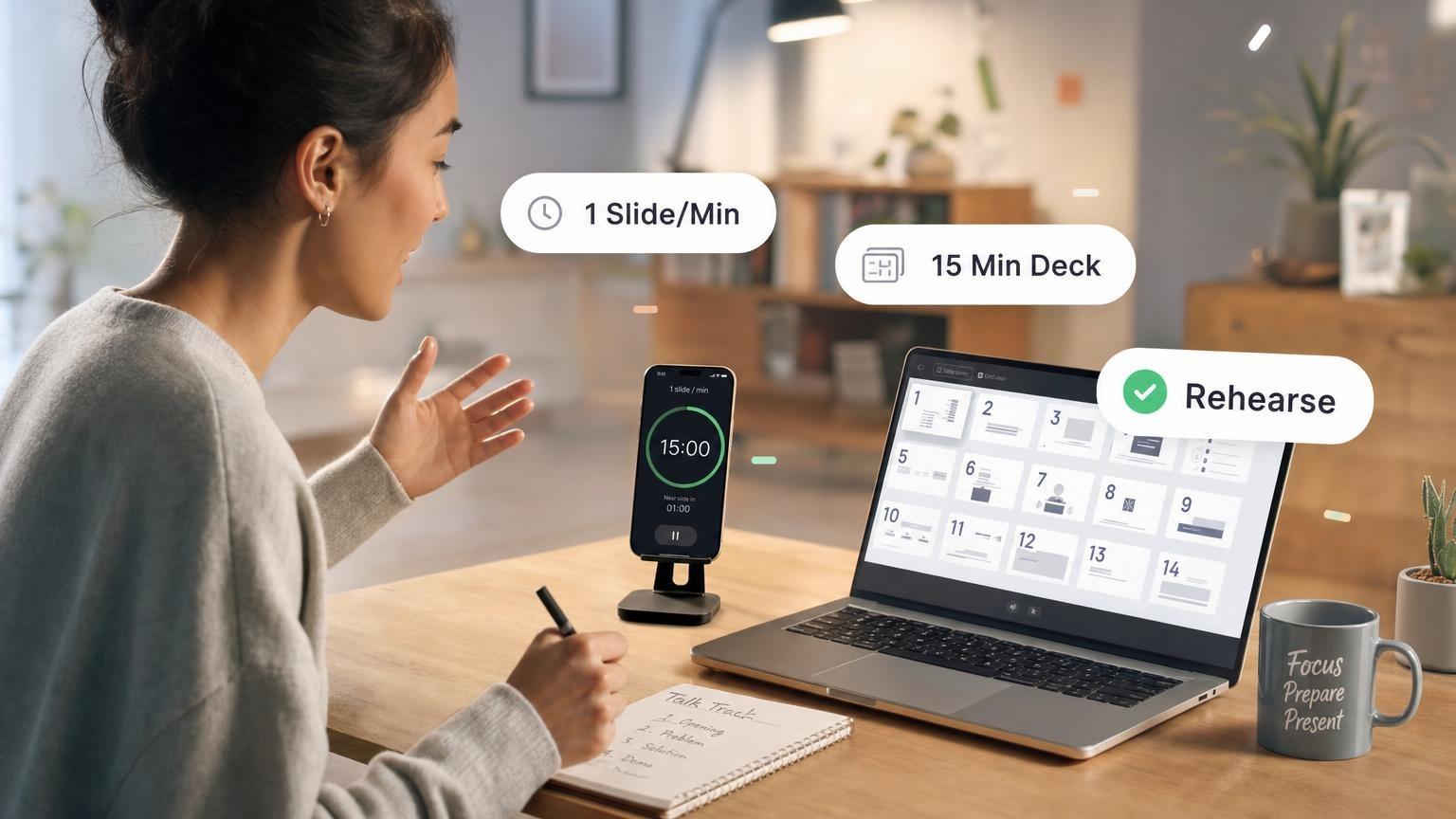
Count minutes, not vanity. A 20-minute meeting with 8 minutes of Q&A means 12 minutes of airtime. At one to two slides per minute you get 12-20 slides if you talk. Most founders talk slower than they think. Cut to 12.
Two files:
- Live. Headlines, one chart, you fill the rest.
- Send. Complete sentences, sources, financial snapshot.
Do not email the live file.
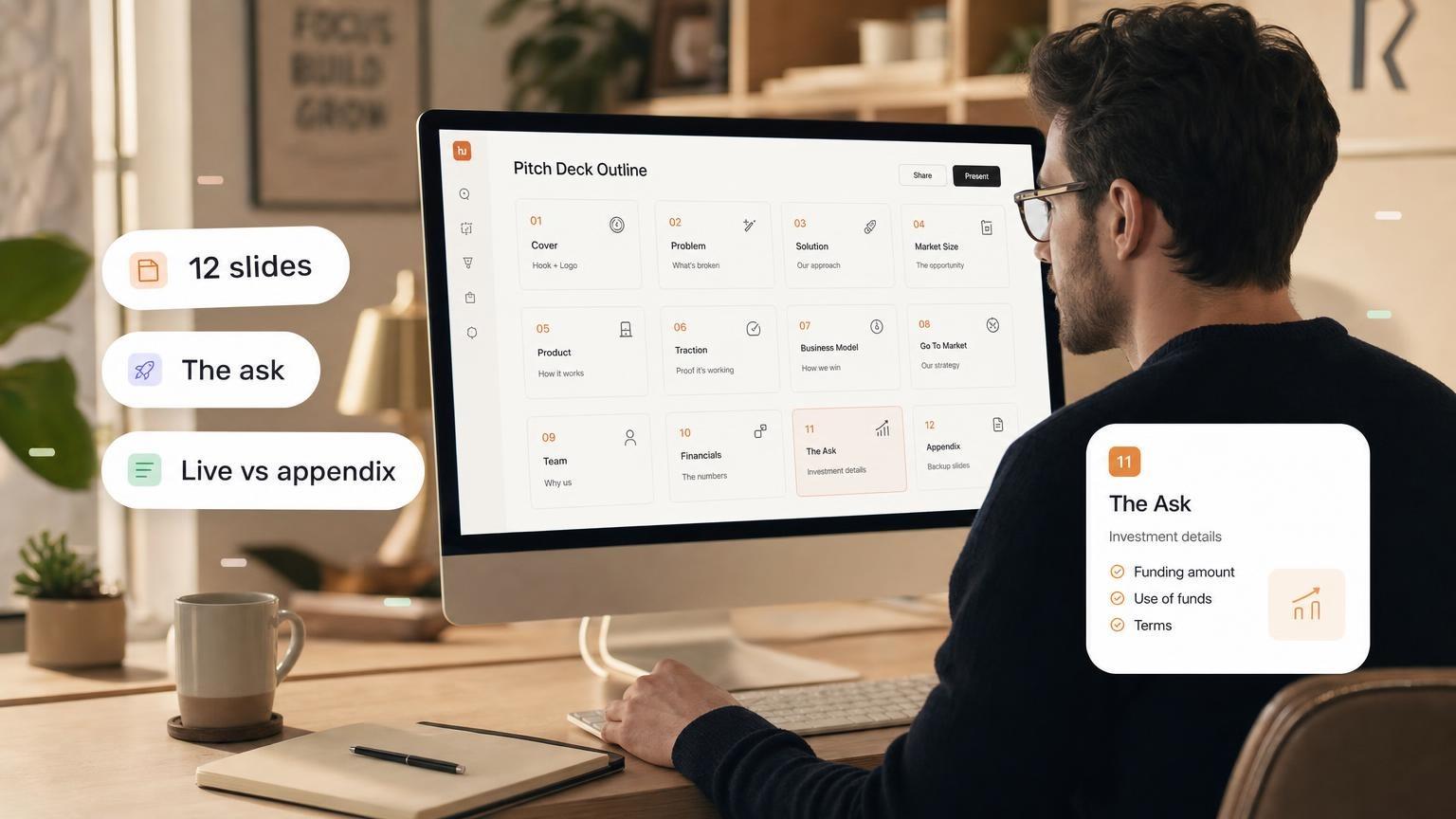
The 12-slide order
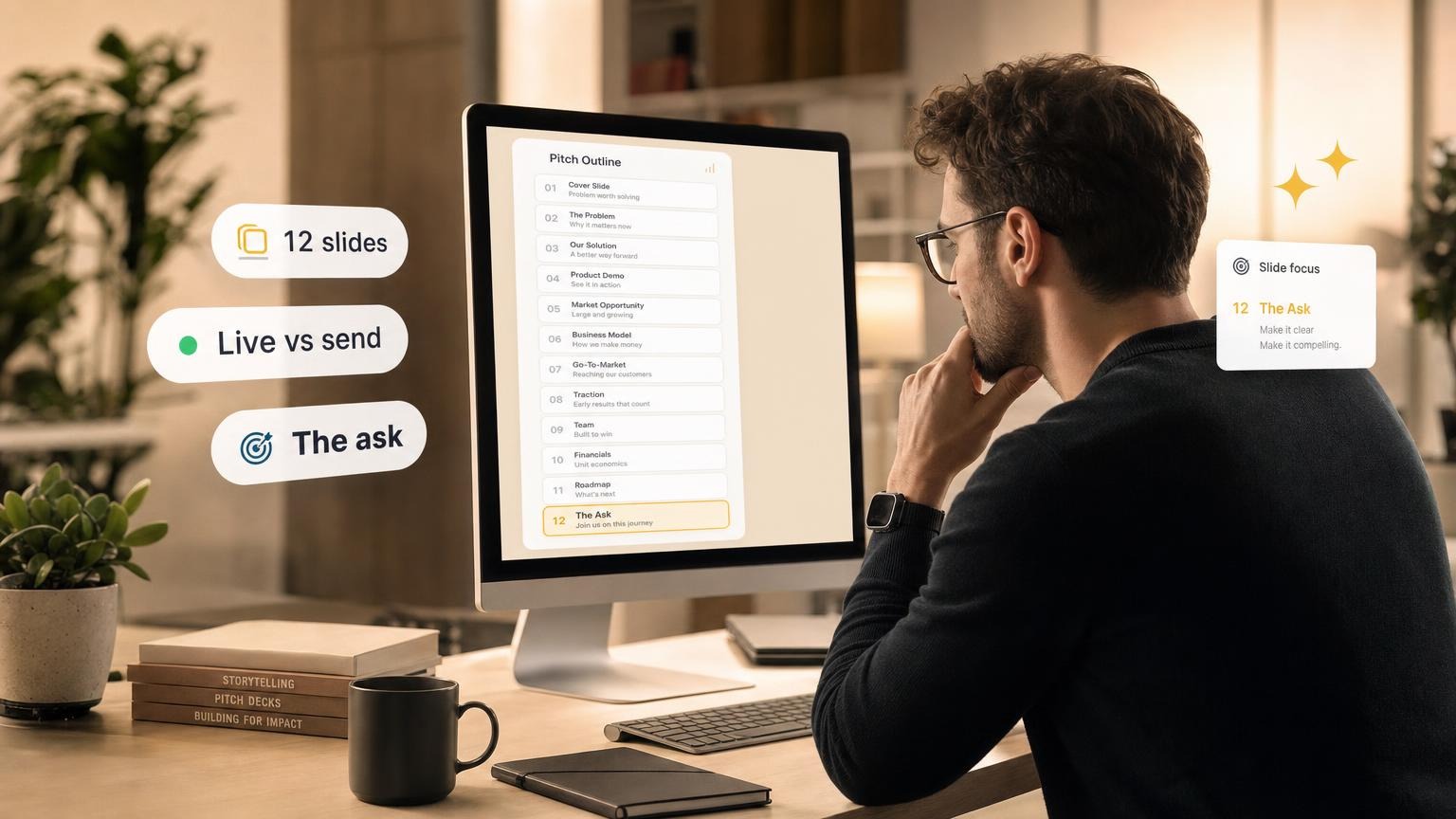
| # | Slide | Job in one sentence |
|---|---|---|
| 1 | Title | Company, one-liner a partner can repeat, round + raise amount if this is a send file |
| 2 | Problem | Named customer, painful frequency, current workaround |
| 3 | Why now | The change that makes this solvable this year |
| 4 | Market | Bottom-up TAM you can actually sell into in 5 years |
| 5 | Product | Screenshot or workflow. What they do on Tuesday |
| 6 | Insight / why us | The non-obvious bet. Not a feature list |
| 7 | Model | How money arrives. Price, who pays, frequency |
| 8 | Traction | One chart. Revenue, waitlist, or usage. No vanity spaghetti |
| 9 | Go-to-market | First channel that already works, then the second |
| 10 | Competition | 2x2 or "us vs status quo." Status quo is usually the real rival |
| 11 | Team | Why this group ships this product. Domain scars, not logos of schools |
| 12 | The ask | Amount, use of funds in 3 buckets, 18-month milestones |
Optional 13: vision slide after traction, never before proof.
For a seed-specific sequence with more narrative notes, see how to sequence a seed pitch deck. For a competition slide that is not a logo junkyard, see how to build a competition slide.
Title
One line a tired partner can text to another partner. "Airbnb for X" only works if X is obvious. Prefer "We [do job] for [who] so they [outcome]."
Problem
Put a person on the slide. "Mid-market CFOs close the books in 18 days using six spreadsheets" beats "finance is broken."
Why now
Regulation, a platform shift, a cost drop, a behavior that already changed. If nothing changed, you are early or you are a feature.
Market
Show the math. 2,000 companies × $12k ACV = $24M SAM you can name. Giant top-down TAM without a wedge looks like you have not sold.
Product
One workflow. Three numbered steps max. If you need six screenshots, the product is not clear yet.
Insight
This is the slide most templates skip. It is why a smart investor leans in. "Everyone else sells seats. Buyers actually pay per closed book."
Model
Price, payer, motion (self-serve, sales-led, usage). One sentence on gross margin if it is unusual.
Traction
Pick the number that predicts revenue. For seed, that can be design partners and paid pilots. Do not mix five axes on one chart.
GTM
Name the first 50 customers and how you reached them. "We'll hire 8 AEs" is not a motion.
Competition
Include "do nothing" and Excel. If your only competitors are well-funded startups, you look late.
Team
One line per founder: relevant win, relevant scar. Advisors only if they are actually in the weekly Slack.
The ask
$3.5M. 18 months. 50% product, 30% GTM, 20% ops. Milestone: $1.2M ARR, 8 weeks payback. Investors should be able to argue the plan, not hunt for it.
What partners open first
Cold PDF and live room are different documents.
| Cold send (DocSend / email) | Live room | |
|---|---|---|
| First 20 seconds | Title one-liner, then traction | Problem scene, then why now |
| Second click | Team, then the ask | Product, then insight |
| If they bounce | They never saw your market story | You can still recover in Q&A |
Build the send file so traction, team, and ask work if they never play your voiceover.
Bad order (fictional "LedgerClose"): Team, product tour, 9 TAM slides, competition matrix, "next steps." Good order: Title, close-the-books pain, SOX + remote-close why now, bottom-up 2,000 mid-market CFOs, 3-step product, "we sell per close not per seat," $40k ACV, 12 paid pilots, outbound + partner, Excel as rival, founders who closed books at two IPOs, $3.5M ask.
Where mission and vision go
Pitch puts "mission" first. That works as a title one-liner. It fails as slide 2 when there is no proof yet.
- Live: one-liner on the title. Optional vision slide after traction (slide 13).
- Send file: one-liner on the title is enough. A manifesto before numbers looks like a culture deck.
If the company is pre-product, the "vision" is the product slide. Do not also add a poetic mission.
What changes by round
| Round | Overweight | Underweight |
|---|---|---|
| Pre-seed / seed | Team, why now, insight, design partners | Five-year P&L theater |
| Series A | Traction slope, GTM repeatability, early unit economics | Origin story |
| Series B+ | Efficiency, cohort quality, plan vs last raise | "The vision" as slide 2 |
If you are still explaining the category at Series A, the category is not real yet or your deck is.
Airbnb's 2009 deck is still the cleanest public seed example. Walk it slide by slide in the Airbnb pitch deck breakdown. For TV-style pitches, Shark Tank examples show a tighter ask.
Live deck vs appendix
Park in the appendix:
- Full financial model
- Security / SOC 2
- Detailed product roadmap
- Customer case studies
- Hiring plan
- Legal cap table snapshot if they ask
Say "I have the model in the appendix" instead of walking 9 forecast slides in the meeting.
Common order mistakes
- Product before problem. You force the room to reverse-engineer who it is for.
- Team on slide 2 at Series A. They already looked you up.
- Ask missing. Partners should not guess the round size.
- Market before why now. TAM without timing is a trivia slide.
- Competition as a feature matrix. Nobody reads 40 cells.
Lock the outline before you touch colors. Pitches is built for this story. GenPPT is the faster path if you already have a memo or PDF to turn into slides.
A structured deck does not make a bad company fundable. It stops a good company from looking confused.