
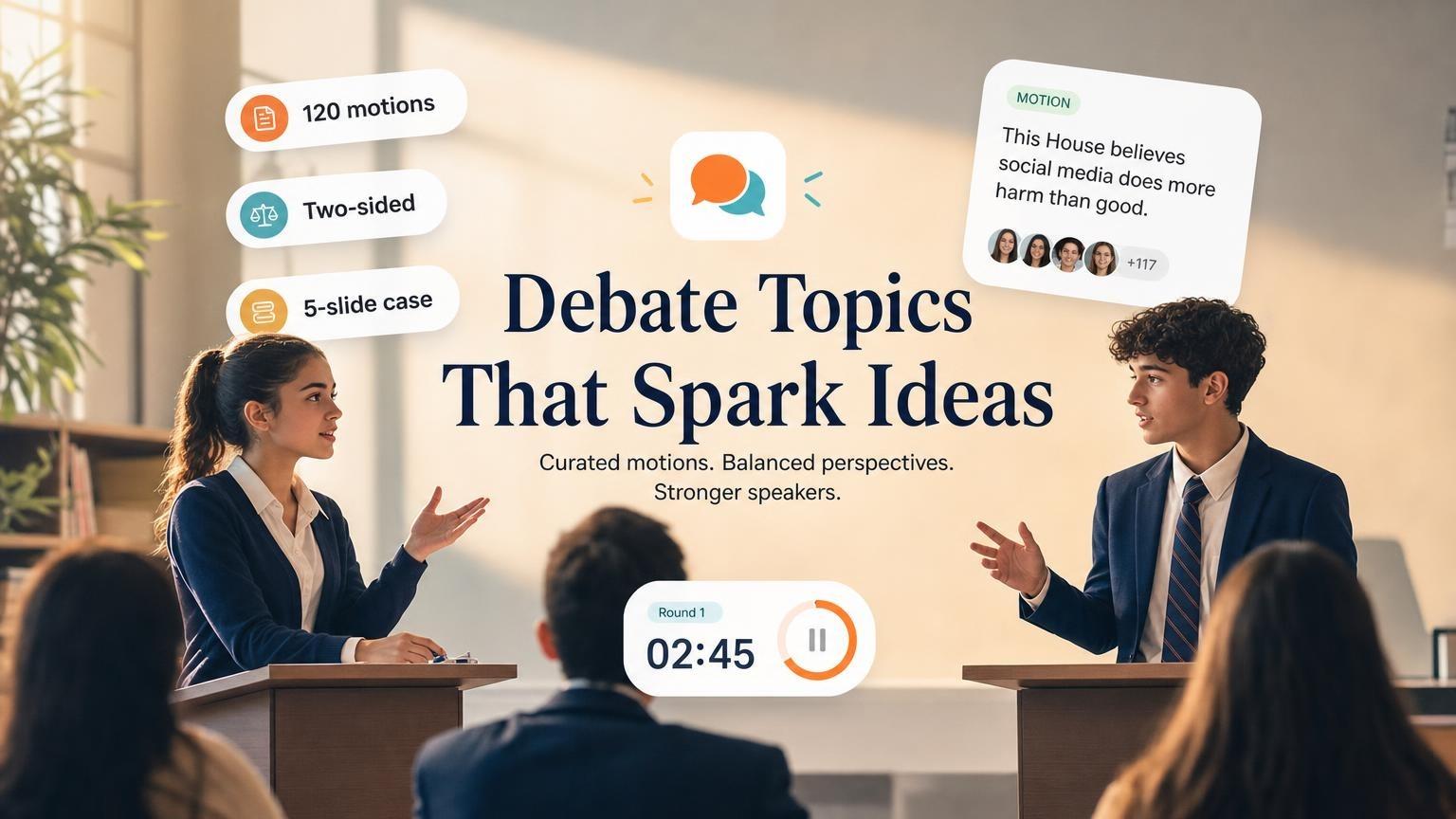
Good debate topics are narrow, two-sided, and finishable in your time box. Three that work: "This house would ban smartphones in high school buildings during class hours", "The voting age should be 16 in local elections", and "A hot dog is a sandwich".
This page has 225 debate topics in 12 groups: by level (kids, middle school, high school, college), by subject, controversial, and funny. It also has the official 2026-27 competition resolutions. The list started at 120 topics and grew.
Tap any topic to open it in GenPPT and start a debate deck on that motion.
10 good debate topics to start with
No time to scroll? Each of these has two real sides and fits a class period.
- This house would ban smartphones in high school buildings during class hoursCreate
- The voting age should be 16 in local electionsCreate
- AI tools should be allowed on homework if disclosedCreate
- School should start at 9:30 or laterCreate
- College athletes in revenue sports should be employeesCreate
- This house would make a four-day, 32-hour week the legal full-time defaultCreate
- Social media should be banned for users under 16Create
- The death penalty should be abolishedCreate
- Dogs make better pets than catsCreate
- A hot dog is a sandwichCreate
Debate topics by group
Pick the list that fits your room. The ten picks above come from these lists.
| Group | Topics | Best for |
|---|---|---|
| Kids (elementary) | 15 | First debates |
| Easy and middle school | 25 | Learning the format |
| High school | 25 | Class debates and club practice |
| College | 25 | Seminars and debate societies |
| Work and policy | 25 | Adults, civics, team offsites |
| Technology and media | 12 | AI, phones, platforms |
| Environment and health | 12 | Science and health classes |
| Government and law | 12 | Civics and history classes |
| Science and ethics | 12 | Biology, physics, philosophy |
| Sports and pop culture | 12 | Reluctant speakers |
| Controversial | 25 | Experienced rooms with ground rules |
| Funny | 25 | Icebreakers and club socials |
| Official 2026-27 | 6 | Competition prep |
What makes a motion work
"Homework should be banned" dies in four minutes. One side has slogans. The other side has every teacher in the building.
Check four things before you pick a topic:
- Clash. Can a reasonable person take either side without becoming a cartoon?
- Scope. Can you define terms in 30 seconds?
- Evidence. News, studies, or lived examples exist for both sides.
- Stakes. Someone in the room cares.
Rewrite "social media is bad" as "This house would ban smartphones in high school buildings during class hours." Now you can argue enforcement, mental health data, and equity.
Weak motion vs. strong motion
A strong motion names who acts, what they do, and where the limit is.
| Weak motion | Problem | Stronger motion |
|---|---|---|
| Social media is bad | No actor, no action | Social media apps should require parental OK under 16 |
| Homework should be banned | Too absolute, so one side only has slogans | Homework should cap at 90 minutes a night by policy |
| AI is dangerous | Too wide to define in 30 seconds | AI hiring screens should be auditable by candidates |
| College is too expensive | A complaint, not a proposal | Public university tuition should be funded by a graduate tax |
| Climate change is real | A fact, so there is no clash | Nuclear should count as green in state subsidy law |
Debate topics for kids (elementary)
Young debaters argue best about things they can see: food, pets, school rules. Keep the rounds short and let every child speak once.
- Dogs make better pets than catsCreate
- Recess should be longer than lunchCreate
- Kids should choose their own bedtime on weekendsCreate
- Summer is better than winterCreate
- Kids should get paid for good gradesCreate
- Elementary schools should replace homework with 20 minutes of readingCreate
- Students should pick their own seatsCreate
- School lunch should include dessert every dayCreate
- Zoos are good for animalsCreate
- Kids under 10 should not have a tablet of their ownCreate
- Reading the book is better than watching the movieCreate
- Students should be allowed to chew gum in classCreate
- Every school should have a gardenCreate
- It is better to be able to fly than to be invisibleCreate
- Every kid should play a team sport for one seasonCreate
Easy and middle school
Use these debate topics for middle school when the class is new to the format. Keep definitions short.
- School should start at 9:30 or laterCreate
- Homework on weekends should be bannedCreate
- Every student should learn a musical instrument for one yearCreate
- Uniforms should be required in public middle schoolsCreate
- Phones should stay in a pouch during classCreate
- Recess should be 40 minutes, not 20Create
- Zoos should only house animals that cannot survive in the wildCreate
- Video games should count as a sport in school clubsCreate
- Students should pick one subject to drop each yearCreate
- Class pets should be allowedCreate
- Junk food should be banned from cafeteriasCreate
- Group projects should be optionalCreate
- Every student should take public speaking in 8th gradeCreate
- Schools should teach cooking as a required classCreate
- Book reports should be replaced by 3-minute talksCreate
- Students should help write classroom rules each termCreate
- Field trips should happen once a monthCreate
- Grades should include a "kindness / collaboration" scoreCreate
- Kids should earn a small wage for choresCreate
- Summer break should be six weeks, with more breaks in winterCreate
- E-books are better than paper for assigned readingCreate
- Competitive sports get too much school money vs artsCreate
- Students should be allowed to retake every test onceCreate
- Pets are better companions than screensCreate
- School should teach basic first aid to every gradeCreate
If the class needs a solo speech first, use these two-minute speech topics as a warm-up.
High school
These debate topics for high school fit a class period or a club practice round. Most are about rules that high school students live under, so both sides have real examples.
- This house would replace most finals with portfoliosCreate
- High school should start after 9 a.m.Create
- Schools should teach personal finance as a graduation requirementCreate
- AI tools should be allowed on homework if disclosedCreate
- The voting age should be 16 in local electionsCreate
- College should not be treated as the default pathCreate
- Dress codes that target girls more than boys should be abolishedCreate
- Standardized tests should not be required for state graduationCreate
- High school athletes should be paid if the school profits from streamingCreate
- Volunteer hours should be required for graduationCreate
- Social media apps should require parental OK under 16Create
- Schools should add a mental health day each quarterCreate
- PE should be optional after grade 10Create
- Students should grade teachers with published summariesCreate
- Debate should be a required semesterCreate
- Phones should be locked away for the full school dayCreate
- Trade certificates should count equal to AP credits for honor rollsCreate
- Schools should not publish class rankCreate
- Teen work permits should allow later hours on non-school nightsCreate
- Schools should teach how recommendation algorithms workCreate
- Gap years should be encouraged, not treated as a riskCreate
- Homework should cap at 90 minutes a night by policyCreate
- Schools should defund stadiums before they cut librariesCreate
- Students should be allowed notes on every non-language examCreate
- Influencer marketing to teens should be labeled like ads on TVCreate
College
College debate topics work when they name the money, the rule, or the right at stake.
- This house would make public university tuition free, funded by a graduate taxCreate
- Unpaid internships at for-profit companies should be illegalCreate
- College athletes in revenue sports should be employeesCreate
- Attendance should not count toward the gradeCreate
- Generative AI should be allowed on take-home work with a methods noteCreate
- General-education requirements should be cut in halfCreate
- Colleges should publish 5-year earnings by majorCreate
- Student evaluations should not affect tenureCreate
- Greek life should lose campus recognition after repeat hazingCreate
- Online degrees from the same faculty should carry the same diplomaCreate
- Campus security should not partner with city police by defaultCreate
- Universities should cap administrator pay relative to faculty mediansCreate
- Speech codes that punish "offensive" but legal speech should goCreate
- Research funded by taxpayers should be open accessCreate
- Colleges should guarantee a paid internship or fail the ranking metricCreate
- Legacy admissions should endCreate
- Student debt for public colleges should be dischargeable in bankruptcyCreate
- Professors should allow lecture recording by defaultCreate
- STEM majors should still require two writing-intensive coursesCreate
- Universities should not run endowment-backed hedge-fund-style riskCreate
- Campus housing should not require meal plansCreate
- SAT/ACT should stay optionalCreate
- Graduate unions should have the same strike rights as staffCreate
- Study abroad should count fully toward the major, not only electivesCreate
- Colleges should require a one-credit "how to cite AI" labCreate
For a talk with no opponent, see these unique college presentation topics and seminar topics.
Work and policy
Use these for adult rooms: team offsites, civics groups, and public speaking clubs.
- This house would make a four-day, 32-hour week the legal full-time defaultCreate
- Remote-first should be the default for knowledge workCreate
- Salary bands should be public inside companies over 200 peopleCreate
- Employers should pay for AI tools rather than ban themCreate
- Universal basic income should be trialed at city scaleCreate
- Facial recognition in public streets should be bannedCreate
- Platforms should be liable for political deepfakes during electionsCreate
- Congestion pricing should expand to more city coresCreate
- Nuclear should be treated as green in subsidy lawCreate
- Meat advertising should face the same limits as alcohol in some hoursCreate
- Non-competes should be unenforceable under a salary capCreate
- Interns should never be unpaid, including nonprofits over a budget thresholdCreate
- Companies over 500 employees should publish pay gaps yearlyCreate
- Social media should require ID for political ads, not for all usersCreate
- Public transit should be free at point of use in cities over 1 millionCreate
- AI hiring screens should be auditable by candidatesCreate
- The workweek meeting cap should be 8 hoursCreate
- Gig workers should get portable benefitsCreate
- Cash should remain legal tender for all consumer purchases under $50Create
- Government should buy open-source software by defaultCreate
- Billionaire space tourism should be taxed like luxury aviationCreate
- Schools of medicine should expand faster than new sports palacesCreate
- Local elections should be ranked-choiceCreate
- Data brokers should need opt-in, not opt-outCreate
- A carbon tariff should apply to imports from high-emission gridsCreate
Need a warm-up before a policy round? Use the funny motions as icebreakers, not graded finals.
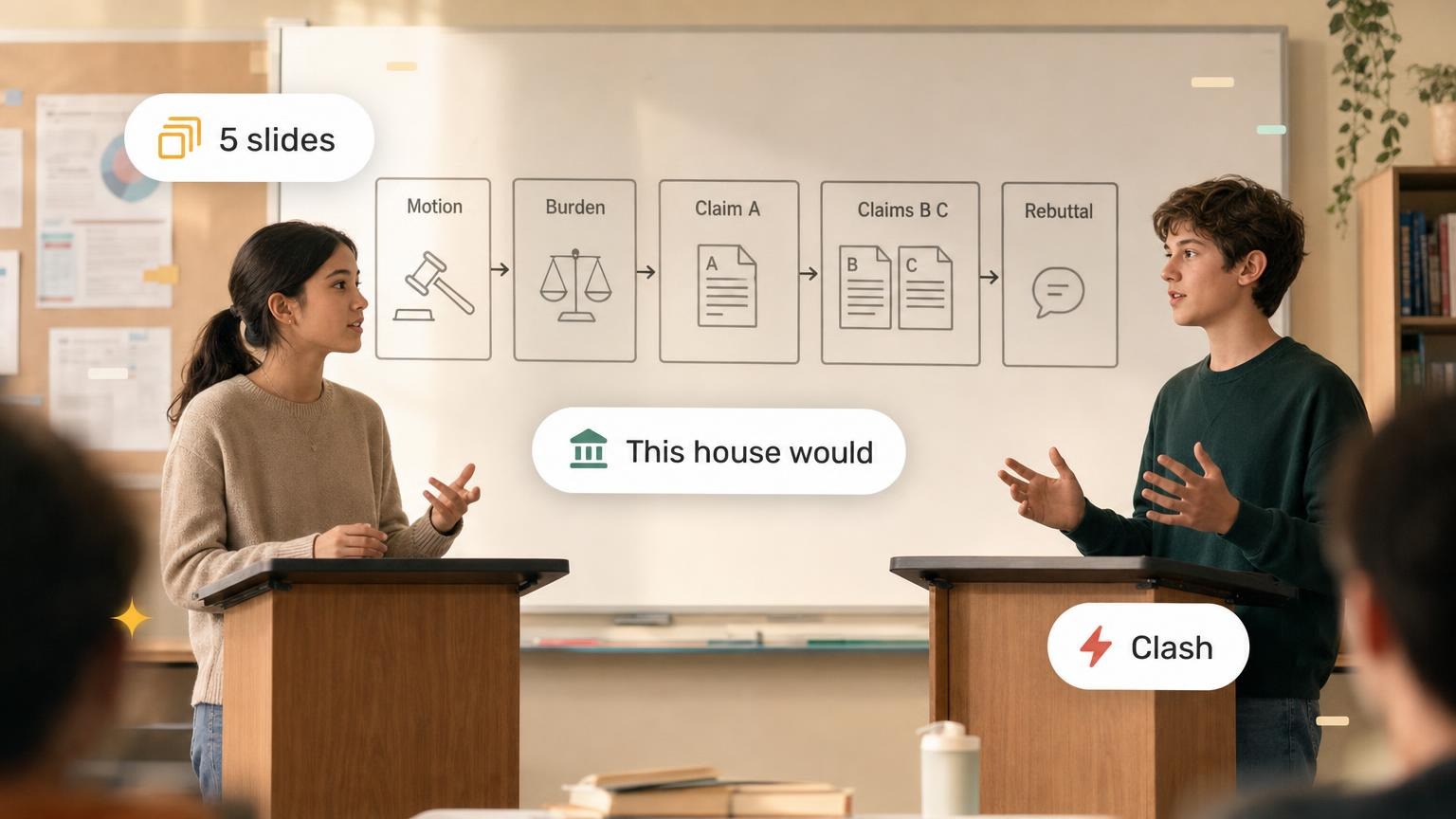
Build a 5-slide debate deck
| Slide | Content |
|---|---|
| 1 | Motion, definitions, time |
| 2 | Burden. What you must prove. What you do not have to prove |
| 3 | Claim A + one fact or example |
| 4 | Claim B + Claim C (or impact) |
| 5 | Rebuttal map + close |
Do not put 40 bullets on slide 3. Speak the case. The deck is a map for judges.
Copy this one-page case template
Fill this in before you open any slide tool. If it does not fit on one page, the topic is too wide.
MOTION: This house would ...
OUR SIDE: Proposition / Opposition
DEFINITIONS (30 seconds): ...
BURDEN: We must prove ... We do not have to prove ...

CLAIM A: ...
  Evidence (source, year): ...
CLAIM B: ...
  Evidence (source, year): ...
CLAIM C: ...
  Evidence (source, year): ...

THEY WILL SAY 1: ...   OUR ANSWER: ...
THEY WILL SAY 2: ...   OUR ANSWER: ...

CLOSE (one sentence): ...
Turn the case into slides
Type the motion into GenPPT, or upload your case notes as a PDF, Word document, or text file. GenPPT researches the topic and drafts an outline. You approve the outline and pick a visual concept.
The slides take about 2 to 3 minutes to generate after you approve the outline. You edit them in chat, then export to PowerPoint (.pptx) or PDF. The .pptx file opens in PowerPoint, Google Slides, and Keynote.
Two limits. The slides are image-native designs, so charts do not link to Excel. And you must check every number and source yourself before you cite it in a round.
There is no free plan. The $1 trial gives you 3 days of full access (card required), then it is $25/month or $99/year. See pricing.
Worked case: high school AI homework
Motion. This house would allow AI tools on homework if the student discloses the tool and the prompt.
Definitions (30s). Homework = take-home work that is not a seated exam. Disclose = tool name + prompt pasted in an appendix.
Claim A. Disclosure trains a skill that employers already use. Evidence to find: job postings that list an AI assistant as a tool, not a cheat.
Claim B. Ban-only policies push use into secret and make grading random. Evidence to find: honor-code cases where the school could not prove authorship.
Claim C. Exams can stay closed-tool. The motion does not touch seated tests.
Predicted rebuttals. "Equity: not everyone has a paid model" (answer: school-provided accounts). "Students will not learn" (answer: grade the process notes, not only the essay).
The opposition in three lines. Disclosure cannot be checked, so honest students lose to students who hide their use. You cannot judge AI output in a subject you have not learned yet. Access stays unequal until the school pays for the accounts.
Map to the 5-slide table: motion, burden, A, B+C, rebuttal map.
Technology and media
- This house would ban smartphones in high school buildings during class hoursCreate
- Platforms should be liable for political deepfakes 60 days before an electionCreate
- Schools should teach how recommendation algorithms work as a required semesterCreate
- Anonymous accounts should be banned on platforms used by under-16sCreate
- AI-generated homework should be labeled or it is an honor-code failCreate
- Facial recognition should stay out of school hallwaysCreate
- Short-form video should not count as a cited source in research papersCreate
- Teen influencers selling to other teens should face the same rules as TV adsCreate
- Comment sections on news sites should be off by defaultCreate
- Public libraries should lend Wi-Fi hotspots before they cut hoursCreate
- Deepfake audio of teachers should be a specific offense in the code of conductCreate
- Search engines used in class should default to a "sources on" viewCreate
Environment and health
- This house would treat shade as a public good in city planningCreate
- School cafeterias should drop sugar-sweetened drinksCreate
- Nuclear should count as green in state subsidy lawCreate
- Cities over 1 million should make transit free at the point of useCreate
- Meat advertising to children should face the same hour limits as alcoholCreate
- Mental health days should be a quarterly student right, not a parent excuseCreate
- Congestion pricing should expand before another highway laneCreate
- PFAS in drinking water should trigger a public dashboard, not a PDFCreate
- Fast fashion returns should be taxed, not landfilled in silenceCreate
- Public school vaccine requirements should allow medical exemptions onlyCreate
- Indoor air after wildfire season should have a classroom CO2/PM2.5 ruleCreate
- Hospitals should publish wait times the same way airports publish delaysCreate
Government and law
Each of these names one rule to change, so the round stays on the rule and off the party.
- The Electoral College should be replaced by a national popular voteCreate
- Voting should be mandatory in federal electionsCreate
- Members of Congress should have term limitsCreate
- Supreme Court justices should serve one 18-year termCreate
- Election Day should be a national holidayCreate
- Washington, D.C. should become a stateCreate
- The federal minimum wage should be tied to inflationCreate
- Jury duty should pay the local median daily wageCreate
- People with felony convictions should keep the right to voteCreate
- Cash bail should end for nonviolent offensesCreate
- Police body camera footage should be public within 30 daysCreate
- Members of Congress should not trade individual stocksCreate
Science and ethics
- This house would allow gene editing of embryos to prevent serious diseaseCreate
- Animal testing for cosmetics should be banned nationwideCreate
- Human missions to Mars should wait until the Moon has a permanent baseCreate
- Lab-grown meat should follow the same label rules as meatCreate
- Organ donation should be opt-out, not opt-inCreate
- De-extinction money should go to living endangered species insteadCreate
- Self-driving cars should need a human ready to take overCreate
- Space mining rights should be shared by treaty, not claimed by companiesCreate
- Schools should teach statistics before calculusCreate
- AI systems should not make final decisions in medical triageCreate
- Geoengineering research should be publicly fundedCreate
- Consumer brain implants should need the same approval as drugsCreate
Sports and pop culture
Reluctant speakers talk more when they already have an opinion. Start here.
- High school teams should have a no-cut policy for freshmenCreate
- Esports should be an Olympic eventCreate
- Youth tackle football should be banned under age 12Create
- Video replay should decide every close call in pro sportsCreate
- Participation trophies do more harm than goodCreate
- Streaming has made movies worseCreate
- AI-generated music should be labeled on streaming platformsCreate
- Award shows should drop gendered acting categoriesCreate
- Remakes and sequels get too much studio moneyCreate
- Celebrities should not endorse political candidatesCreate
- Concert ticket resale should be capped at face valueCreate
- Reality TV does more harm than goodCreate
Controversial debate topics
Controversial topics split a room on values, not only on facts. They suit debaters who know the format and a room that has agreed on ground rules.
Three rules keep the round on the argument:
- Debate a policy, not a group of people. No motion should put a student's identity, family, or faith on trial.
- Assign sides by coin flip. Arguing the side you disagree with is the exercise.
- Require a source for every factual claim. "Everyone knows" is not evidence.
- The death penalty should be abolishedCreate
- The United States should adopt single-payer health careCreate
- Background checks should be required for every gun saleCreate
- Assault-style weapons should be banned from civilian saleCreate
- Undocumented residents should have a path to citizenshipCreate
- A wealth tax should apply to fortunes over $50 millionCreate
- The federal minimum wage should be $20Create
- Student loan debt should be canceled up to a fixed capCreate
- Colleges should be allowed to consider race in admissionsCreate
- Hate speech should be a criminal offenseCreate
- Section 230 protection for social platforms should be repealedCreate
- Social media should be banned for users under 16Create
- Physician-assisted dying should be legal for terminally ill adultsCreate
- Recreational marijuana should be legal nationwideCreate
- Drug possession for personal use should be decriminalizedCreate
- Photo ID should be required to vote in federal electionsCreate
- Cities should move police funds to mental health response teamsCreate
- Abortion law should be set at the federal level, not by the statesCreate
- Reparations should be paid to descendants of enslaved peopleCreate
- Rich countries should pay climate reparations to developing countriesCreate
- Military draft registration should include womenCreate
- The United States should cut its military budgetCreate
- AI companies should pay creators for training dataCreate
- Police should get access to encrypted messages with a warrantCreate
- Public money should fund private school vouchersCreate
Funny motions (icebreakers, not finals)
Funny debate topics teach the format without the homework. Define terms or the round is a meme.
- Pineapple belongs on pizzaCreate
- Cereal is a soupCreate
- A hot dog is a sandwichCreate
- Pets should be allowed at the officeCreate
- Movies should cap at 100 minutesCreate
- Group chats need a mute window after 10 p.m.Create
- Morning people should not schedule 8 a.m. debatesCreate
- Leftover pizza is a breakfast foodCreate
- Water is wetCreate
- A straw has one hole, not twoCreate
- Toilet paper should hang over, not underCreate
- Milk goes in the bowl before the cerealCreate
- Socks with sandals are acceptableCreate
- A taco is a sandwichCreate
- Cats would run the world better than dogsCreate
- One horse-sized duck is easier to fight than 100 duck-sized horsesCreate
- Invisibility is a better superpower than flightCreate
- The middle seat gets both armrestsCreate
- Reply-all should need a second confirmationCreate
- Pajamas count as business casual when you work from homeCreate
- The office thermostat should be decided by voteCreate
- Die Hard is a holiday movieCreate
- Pluto should be a planet againCreate
- The corner brownie is better than the middle pieceCreate
- Monday should move to the middle of the weekCreate
Run them like a real round: one definition, two claims, one rebuttal, two minutes per speaker.
Official 2026-27 debate resolutions (NSDA)
If you compete in a US high school league, your topic is usually chosen for you. The National Speech and Debate Association (NSDA) publishes the resolutions for its events.
These are the resolutions shown as final on the NSDA topics page, checked on October 2, 2026.
| Event and dates | Resolution | Deck |
|---|---|---|
| Policy, 2026-27 season | The United States federal government should establish national health insurance in the United States. | Create deck |
| Lincoln-Douglas, Sep/Oct 2026 | Outer space colonization is a moral imperative. | Create deck |
| Lincoln-Douglas, Nov/Dec 2026 | De-extinction is unethical. | Create deck |
| Public Forum, Sep/Oct 2026 | The United States federal government should enact a moratorium on hyperscale data center construction. | Create deck |
| Public Forum, Nov/Dec 2026 | European members of the North Atlantic Treaty Organization should ratify the Treaty on the Prohibition of Nuclear Weapons. | Create deck |
| Big Questions, 2026-27 season | Technological progress has surpassed humanity's ability to use it ethically. | Create deck |
Later Lincoln-Douglas and Public Forum slots (January 2027 onward) were still listed as options when we checked. Read the NSDA page for the final wording before you prep.
Debate formats and the topic each one needs
The format decides what kind of topic works. A policy round needs a plan. A values round needs a moral claim.
| Format | Debaters | Topic changes | Topic type |
|---|---|---|---|
| Policy | 2 vs 2 | Once a year | A policy proposal |
| Lincoln-Douglas | 1 vs 1 | Every two months | Morality, philosophy, justice |
| Public Forum | 2 vs 2 | Every one or two months | Current events |
| World Schools | 3 vs 3 | Varies by tournament | Prepared and impromptu motions |
| Class debate | Two teams | Your choice | Any motion that passes the four checks |
The first four rows follow the event descriptions on the NSDA competition events page and the schedule on its topics page.
For a class debate, write the motion in the style of the format you want to teach. "This house would..." gives you a policy round. "X is unjust" or "X ought to..." gives you a values round.
Run a class debate in 45 minutes
This schedule gives each side 9 minutes of speaking time and fits one class period. Copy it and change the times to fit your room.
| Step | Time | Who |
|---|---|---|
| Motion and definitions | 2 min | Teacher or chair |
| Team prep | 8 min | Both teams |
| Opening speech | 4 min each | Proposition, then opposition |
| Questions from the floor | 6 min | Audience |
| Rebuttal | 3 min each | Proposition, then opposition |
| Closing | 2 min each | Opposition, then proposition |
| Vote and feedback | 6 min | Audience and teacher |
That is 40 minutes. The other 5 cover moving chairs and late starts.
Give the audience a job: each listener writes down the best argument from the side they disagree with. The vote is on who argued better, not on who they agreed with at the start.
FAQ
What are the best debate topics for students?
The best debate topics for students have clash and fit a time box: school start times, phones in class, AI on homework with disclosure, and college as the default path. Students argue them well because they live under these rules. Start with the high school list for ages 14 to 18 and the easy and middle school list for younger classes.
What are easy debate topics for beginners?
Uniforms, weekend homework, class pets, and "pineapple belongs on pizza" are easy first topics. Each side can find three reasons without research. Use them to learn the format, then move to policy motions.
What are some funny debate topics?
"A hot dog is a sandwich", "cereal is a soup", "water is wet", and "the middle seat gets both armrests" are reliable. They work because the whole round turns on a definition. There are 25 in the funny motions list.
What are controversial debate topics for high school?
The death penalty, gun background checks, a social media ban under 16, and student loan cancellation are common picks. Write each one as a specific policy and assign sides by coin flip. Do not use motions that put a student's identity, family, or faith on trial. See the controversial debate topics list and its three ground rules.
How do I choose a good debate topic?
Run four checks: clash, scope, evidence, stakes. Kill the topic if one side only has slogans, or if you cannot define the terms in 30 seconds. Then match it to the room and the time you have.
What are good college debate topics?
Tuition models, unpaid internships, athlete employment, open access to research, and campus speech codes. Good college motions name the money, the rule, or the right at stake. The college list has 25.
How do I prepare a case?
Write the definitions and the burden first. Then write three claims with one source each, and two rebuttals you expect from the other side. Put the case on five slides: motion, burden, claims, rebuttal map, close.
More topic lists
A debate needs two sides. If you speak alone, start with one of these:
- Informative speech topics for a talk that explains and does not argue.
- TED talk topics for one idea told as a story.
- Two-minute speech topics for short speaking practice.
- Unique college presentation topics for a graded class talk.
- Seminar topics for a longer research presentation.
Have your motion? Build the case deck now.