
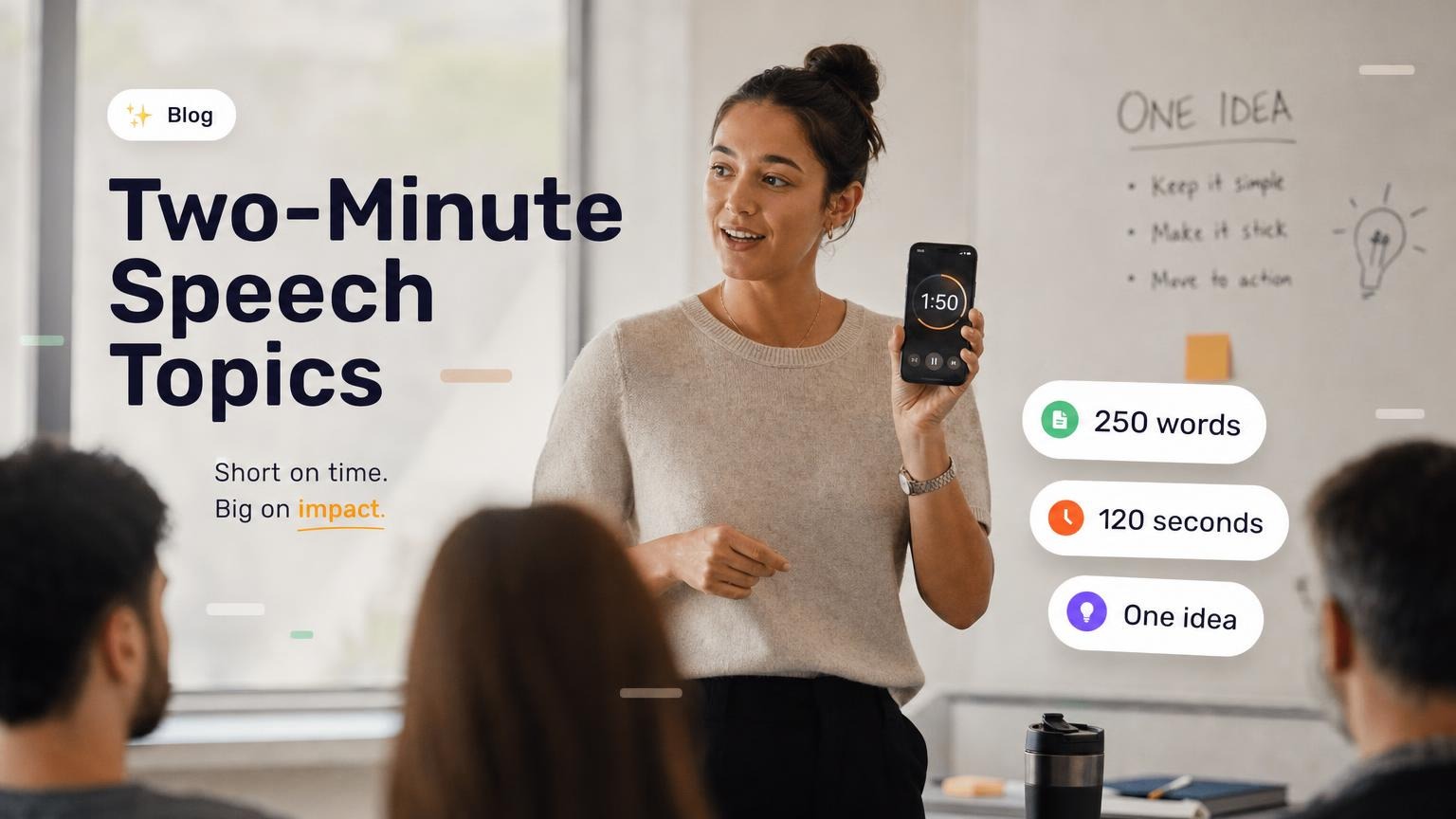
Good 2-minute speech topics are narrow: one scene, one point, one example. "The assignment I still remember" works. "Climate change" does not. A 2-minute speech is 260 to 300 words, so you have room for one idea and no more.
This page has 80 topics for school, work, and personal life, plus more than 130 others: easy starters, grade-level lists, persuasive, informative, funny, impromptu, and 1-minute prompts. You also get a 120-second script, a word-count table, and a full sample speech.
Easy 2-minute speech topics to start with
These 12 topics cover the classic class themes: values, environment, technology, health, and study habits. Each one is narrowed to one scene, so it fits the clock.
- The day honesty cost me somethingCreate
- One small way to save water at homeCreate
- How I stopped procrastinating on one assignmentCreate
- What a week without social media taught meCreate
- Why kindness is a skill you practiceCreate
- The time management trick that works for meCreate
- How AI helped me study, and where it was wrongCreate
- The tree I planted and what happened to itCreate
- A healthy habit that takes two minutesCreate
- The person who taught me disciplineCreate
- My favorite hobby and what it gave meCreate
- One thing I am grateful for this weekCreate
Tap a topic only if you also need slides for it. For more lists, go to school, work, or personal and civic topics.
How many words is a 2-minute speech?
A 2-minute speech is about 260 to 300 words. The National Center for Voice and Speech puts the average rate for English speakers in the United States at about 150 words per minute. That gives you 300 words in two minutes.
That figure is an average. In front of a room you pause, breathe, and wait for a laugh. Plan for 130 words per minute, which is 260 words.
| Pace | Words per minute | Words in 2 minutes |
|---|---|---|
| Slow, with long pauses | 110 | 220 |
| Steady speech pace | 130 | 260 |
| Average rate (NCVS) | 150 | 300 |
| Fast | 160 | 320 |
The same math works for other time limits:
| Speech length | At 130 wpm | At 150 wpm |
|---|---|---|
| 1 minute | 130 words | 150 words |
| 2 minutes | 260 words | 300 words |
| 3 minutes | 390 words | 450 words |
| 5 minutes | 650 words | 750 words |
Your own rate is the only number that counts. Read 130 words out loud with a phone timer. If you finish in under a minute, you speak fast and can write more.
The 120-second shape
- Hook. A specific moment. Not a dictionary definition.
- Point. One sentence they could text to a friend.
- Example. Names, numbers, a place.
- So-what. Why this room should care.
- Close. Repeat the point in different words. Stop.
Here is the same shape with a time and a word budget for each part. The word counts use 130 words per minute.
| Part | Time | Words | Job |
|---|---|---|---|
| Hook | 15 seconds | About 30 | Put the room in one moment |
| Point | 20 seconds | About 45 | Say the one idea |
| Example | 50 seconds | About 110 | Prove it with one story |
| So-what | 20 seconds | About 45 | Tie it to the listener |
| Close | 15 seconds | About 30 | Repeat the point and stop |
Copy this 2-minute speech template
Fill in the brackets, then read it out loud with a timer.
HOOK (15 seconds, about 30 words)
Last [day], [one specific moment: a place, a person, a number].

POINT (20 seconds, about 45 words)
Here is what I took from it: [one sentence a listener could text to a friend].

EXAMPLE (50 seconds, about 110 words)
[What happened, in order. Names, numbers, a place. One example only.]

SO-WHAT (20 seconds, about 45 words)
This matters to you because [why this room should care].

CLOSE (15 seconds, about 30 words)
So [the point again, in new words]. [One thing to do next.]
Ask if the clock starts when you stand up or when you start to speak. Then practice the same way you will deliver it. For more ways to open, see these presentation hook examples.
How to pick a 2-minute speech topic
Two minutes is not a short TED talk. It is a toast, a class icebreaker, a contest round, or a status update in a sprint review. Match the topic to the occasion.
| Occasion | Topic type that fits | Example |
|---|---|---|
| Class assignment | A personal story with one lesson | The assignment I still remember |
| Speech contest | One claim and one example | Why school should start one hour later |
| Team meeting | A process you changed | Why I write the decision first, then the context |
| Job interview | A result and how you got it | A customer quote that changed the roadmap |
| Toast or icebreaker | A light opinion | Cereal is a soup if you define soup badly |
| Club table topics | A question you answer with PREP | The best advice you ever got |
Then run three checks before you commit:
- Can you say the point in one sentence? If not, the topic is too wide.
- Do you have one true example? A real moment beats three general reasons.
- Can you talk about it without notes? Pick something you know or care about.
Classic themes such as "environment" or "technology" are too wide for two minutes. Narrow each one to a single scene:
| Theme | Too wide | Fits 2 minutes |
|---|---|---|
| Environment | Climate change | One small way to save water at home |
| Technology | Social media: good or bad | What a week without social media taught me |
| Values | Honesty is the best policy | The day honesty cost me something |
| Health | The importance of exercise | A healthy habit that takes two minutes |
| Study | Time management | The time management trick that works for me |
If your topic fails the first check, it needs a longer slot. Try these 10-minute presentation topics or these TED talk topics.
School
These 25 topics are for class speeches. Each one starts from your own life, so you do not need research. Tap a topic if you also need slides for it. For lists by grade level, see 2-minute speech topics for students below.
- Why I read the last page of a book firstCreate
- The school lunch item that should be retiredCreate
- A rule that exists only because one person abused itCreate
- Why I walk without headphones one day a weekCreate
- The best teacher trick I have seenCreate
- What my backpack says I valueCreate
- A lab safety fail I will not repeatCreate
- Why group chats need a mute windowCreate
- The club nobody joins and shouldCreate
- How I actually study the night beforeCreate
- A library book that changed a week, not my lifeCreate
- Why I keep a paper calendarCreate
- The bus ride as a classroomCreate
- A sport I play badly on purposeCreate
- Why we should learn one song on an instrumentCreate
- The assignment I still rememberCreate
- How I explain my hometown in 20 secondsCreate
- A cafeteria seat politics guideCreate
- Why I draft on paperCreate
- The rumor that wasted a weekCreate
- A plant in a classroom and what it taughtCreate
- Why I hate "participation points"Create
- The field trip that was actually worth the formCreate
- How I ask for help without shrinkingCreate
- A word I stopped usingCreate
2-minute speech topics for students
These 40 topics are sorted by grade level. The younger lists are about things you know first-hand. The older lists add an opinion you must defend.
Elementary school
- My favorite animal and one strange fact about itCreate
- The best game to play at recessCreate
- If I could have one superpower for a dayCreate
- How to take care of a petCreate
- The best book my teacher read to our classCreate
- Why my grandparent is my heroCreate
- What I would put in a time capsuleCreate
- How to make my favorite sandwichCreate
- The one rule I would add to our classroomCreate
- A place I want to visit and whyCreate
Middle school
- Why school should start one hour laterCreate
- The app I would delete from every phoneCreate
- What I learned from losing a gameCreate
- Why every student should learn to cook one mealCreate
- A book that is better than its movieCreate
- How I calm down before a testCreate
- Why homework should have a time limitCreate
- The invention I use every day and never think aboutCreate
- What a good friend does when you failCreate
- Why kindness is harder onlineCreate
High school
- Why sleep matters more than one more hour of studyCreate
- What social media does to my attentionCreate
- The first money lesson schools should teachCreate
- Why a part-time job teaches more than a classCreate
- How I would change the grading systemCreate
- Should phones stay in lockers during classCreate
- The college pressure nobody talks aboutCreate
- What volunteering taught me in one afternoonCreate
- Why failing a test was usefulCreate
- How to disagree with a friend and stay friendsCreate
College
- The one habit that fixed my first semesterCreate
- Why office hours are the most wasted resource on campusCreate
- How I budget on a student incomeCreate
- What a gap year teaches that a lecture does notCreate
- Should attendance count toward a gradeCreate
- The class outside my major that changed how I thinkCreate
- How to use AI for study without letting it think for youCreate
- Why group projects fail and one fixCreate
- The internship lesson that no course coveredCreate
- What I would tell myself on move-in dayCreate
Work
These 25 topics fit a standup, a team meeting, an all-hands slot, or an interview answer.
- The meeting that should have been a 12-line docCreate
- Why I write the decision first, then the contextCreate
- A vendor email I should not have sentCreate
- The standup lie: "no blockers"Create
- Why I keep a "done" list, not a to-do listCreate
- How I say no to a "quick call"Create
- The spreadsheet everyone fearsCreate
- Why I narrate a bug before I fix itCreate
- An onboarding doc that was a trapCreate
- The Slack emoji that means "I disagree"Create
- Why I calendar lunchCreate
- How I prep a 2-minute status for a VPCreate
- The tool we bought and never openedCreate
- A customer quote that changed the roadmapCreate
- Why I read contracts' termination clauses firstCreate
- The hallway ask that wrecked a sprintCreate
- How I hand off work on a FridayCreate
- A metric we gamedCreate
- Why I still print the agendaCreate
- The intern who saved a launchCreate
- How I file a bug so it gets fixedCreate
- A "culture deck" vs TuesdayCreate
- Why I record the demo, then send itCreate
- The time I over-explained and lost the roomCreate
- A small process I would keep in any jobCreate
Personal and civic
These 30 topics work for clubs, community meetings, toasts, and adult speaking classes.
- Why I learned my neighbors' namesCreate
- A bus route as a city tourCreate
- The park that is actually usedCreate
- Why I vote in localsCreate
- A family recipe I cannot mess upCreate
- The object I would save in a fire (and the honest reason)Create
- Why I wait 24 hours to reply angryCreate
- A public comment I wish I had givenCreate
- How I explain my job to a 10-year-oldCreate
- The news habit I droppedCreate
- Why I carry cash for one kind of shopCreate
- A repair I did instead of replacingCreate
- The community fridgeCreate
- Why I take the stairs with a ruleCreate
- A local election I trackedCreate
- How I pack for two daysCreate
- The compliment that was actually usefulCreate
- Why I keep analog photosCreate
- A law I misunderstood until it hit meCreate
- The friend who is my editorCreate
- Why I go to the library when I cannot workCreate
- A small courtesy that is dyingCreate
- How I pick a charity without a videoCreate
- The street that needs a lightCreate
- Why I write thank-you notes on paperCreate
- A mistake I made in publicCreate
- How I explain "no" to familyCreate
- The podcast I turned offCreate
- Why I still use a dumb alarm clockCreate
- A two-minute speech about why two-minute speeches workCreate
Persuasive 2-minute speech topics
A persuasive speech at this length has one claim and one example. Do not try a three-part case. If you want both sides of a question, use these debate topics.
- Schools should teach personal finance before graduationCreate
- Every meeting needs a written agenda or it gets canceledCreate
- Cities should make public transit free for studentsCreate
- Phones do not belong on the dinner tableCreate
- Everyone should learn basic first aidCreate
- The four-day school week deserves a trialCreate
- You should read the terms before you click acceptCreate
- Homework over holidays should endCreate
- Election day should be a public holidayCreate
- Every adult should know how to cook five mealsCreate
- Libraries deserve more funding than stadiumsCreate
- Group projects should be graded per personCreate
Informative 2-minute speech topics
An informative speech explains one thing. Pick a single process or a single fact, and check it against a source before you speak. For more, see these informative speech topics.
- How a vaccine trains your immune systemCreate
- Why the sky is blue, in plain wordsCreate
- How compound interest works with one exampleCreate
- What happens to a plastic bottle after you recycle itCreate
- How noise-canceling headphones cancel noiseCreate
- Why we have leap yearsCreate
- How a bill becomes a lawCreate
- What a credit score measuresCreate
- How bees make honeyCreate
- Why airplanes stay in the airCreate
- How GPS knows where you areCreate
- What caffeine does in your brainCreate
If you must use slides
Most 2-minute speeches need no slides. If your teacher or manager requires them, use three, no more:
- Title + your point in 8 words
- One photo or one number
- Recap
If you need six slides, the topic is a 10-minute talk. See how many slides per minute for the math on longer slots.
GenPPT can make the three slides from your topic. It researches the topic, drafts an outline that you approve, and then designs the slides. That takes about 2 to 3 minutes after you approve the outline. Write "three slides" in your prompt and check the outline before you approve it.
You can export to PowerPoint (.pptx) or PDF. GenPPT writes the slide text from its own research, so check every number and claim before you present.
GenPPT is a paid tool. A $1 trial gives you 3 days of full access (card required). After that it is $25/month or $99/year. There is no free plan.
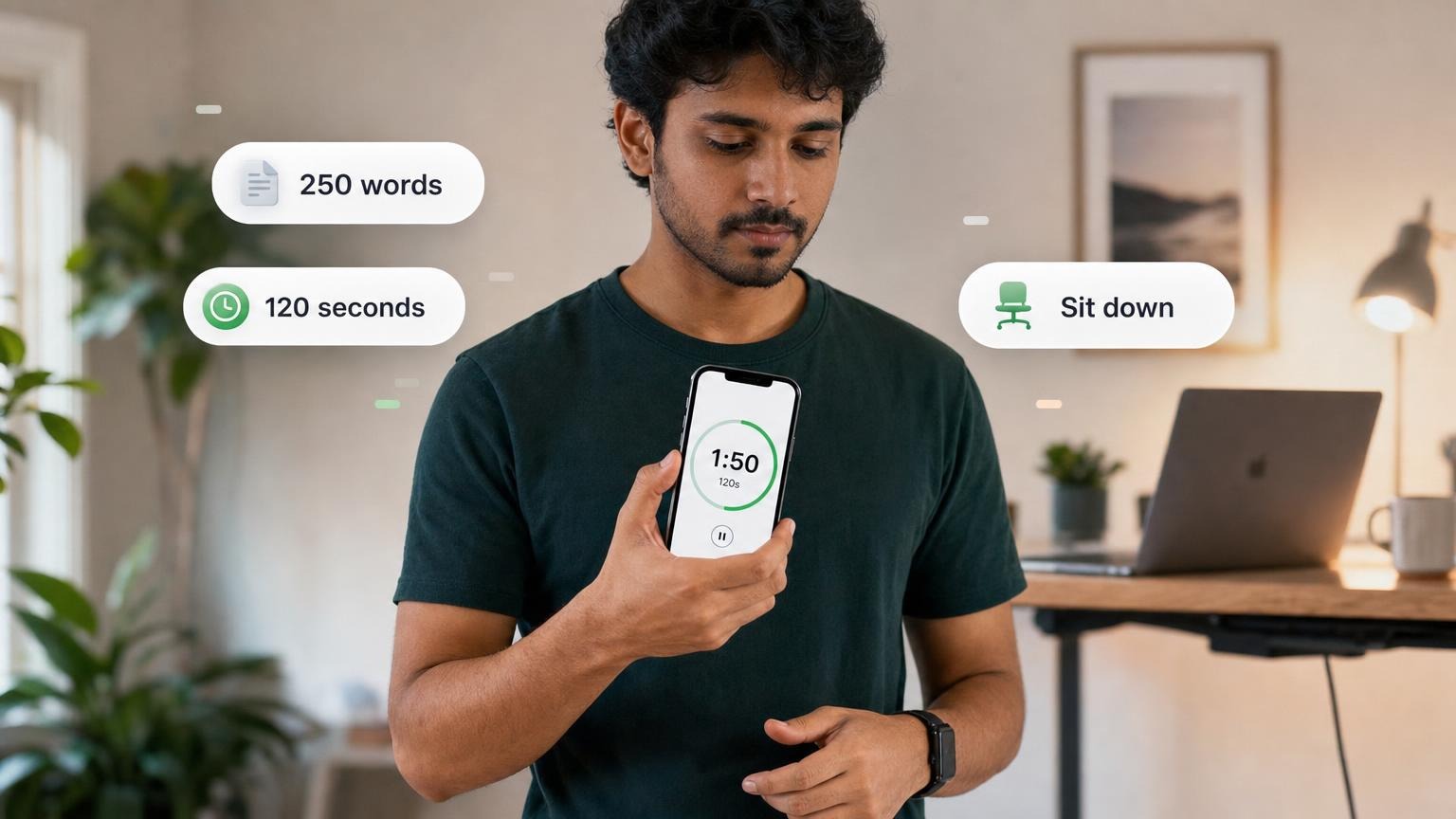
250 words, then cut to 1:50
Write the speech. Read it standing with a phone timer. First drafts usually run long. Cut the preamble and the second example.
Use this order:
- Draft 250 words. Use the template above.
- Time it out loud. Silent reading is faster than speech, so it does not count.
- Cut, do not speed up. Remove the greeting, the "today I will talk about" line, and any second story.
- Mark two pauses. One after the hook and one before the close.
- Time it again. Stop when you land at 1:50. The spare 10 seconds cover nerves and a laugh.
If the topic needs a "should," you are in persuasive. Keep one claim + one example, or use debate topics.
Sample speech (~250 words): the meeting that should have been a 12-line doc
Hook (15 seconds). Last Tuesday, six of us sat in a conference room for 35 minutes to pick the color of one button. Six people. One button. We left without a decision, and with a second meeting on the calendar.
Point (20 seconds). Here is my rule now. If a decision fits in 12 lines, write the 12 lines. Do not book a meeting to watch people read. A meeting is the most expensive way to share one paragraph.
Example (50 seconds). So on Wednesday I tried it. I wrote the decision first, at the top: ship the blue button. Then three reasons. The contrast passes the accessibility check. The brand palette already has that blue. QA already has a build with it. Under that I put the context: two screenshots, the ticket number, and the names of the two people who disagreed.
I sent it at 9:12. By 9:40, both of them had objected in the comments, I had answered, and one of them had changed my mind about the hover state. We shipped at 11. Nobody booked a room. Nobody lost a morning.
So-what (20 seconds). Meetings are for conflict that will not fit in text. Status updates, button colors, and "any other business" are not that. Each one is a doc that pretends to be a meeting, and the whole team pays for it.
Close (15 seconds). So the next time your hand goes to the calendar, open a doc. Write the decision first. If it is still messy after 12 lines, then book the room. Not before.
That sample is about 250 words. At 130 words per minute it runs close to 1:55, so one cut gets you to 1:50.
Funny / icebreaker (2 minutes)
A funny 2-minute speech takes a small thing and argues it with total seriousness. Keep the same shape: one claim, one example, one close.
- Why I read the last page firstCreate
- Cereal is a soup if you define soup badlyCreate
- The Slack emoji that means noCreate
- Leftover pizza as breakfastCreate
- Movies that should have ended at 100 minutesCreate
- My backpack as a personality testCreate
- The group chat mute windowCreate
- Why I still use a dumb alarmCreate
- Why my dog is a better listener than my friendsCreate
- A ranking of excuses for late homeworkCreate
- The five stages of losing a sockCreate
- Why Mondays need a warning labelCreate
- How to look busy in a meetingCreate
- Pineapple on pizza: a legal defenseCreate
- What my search history says about my weekCreate
- Why autocorrect is my enemyCreate
- The office microwave as a social experimentCreate
- How to win an argument with a toddlerCreate
- A serious review of the school vending machineCreate
- Why naps should be a graded subjectCreate
Impromptu 2-minute speech topics
An impromptu speech gives you seconds to prepare, not days. At Toastmasters clubs, a Table Topics answer lasts one to two minutes. Use the PREP frame so you always know your next sentence.
| Step | Time | What you say |
|---|---|---|
| Point | 15 seconds | Your answer in one sentence |
| Reason | 25 seconds | Why you think so |
| Example | 60 seconds | One true story that shows it |
| Point | 20 seconds | The answer again, in new words |
Practice with these prompts. Set a timer, read one, and start to speak in 10 seconds.
- The best advice I ever gotCreate
- A skill I want to learn this yearCreate
- The most useful thing I own that cost under $20Create
- A rule I would change at school or workCreate
- My first job and what it taught meCreate
- One thing my city gets rightCreate
- A meal I could eat every dayCreate
- The last time I changed my mindCreate
- A habit I dropped and do not missCreate
- What I would do with one extra hour a dayCreate
- A teacher or boss I still quoteCreate
- The best gift I ever gaveCreate
- One piece of technology I could live withoutCreate
- A mistake that turned out wellCreate
- What I would tell a new student or new hire on day oneCreate
- A place everyone should see onceCreate
- The hardest thing I learned to doCreate
- A book, show or song I recommend to everyoneCreate
- What makes a good neighborCreate
- If I could ask one person one questionCreate
1-minute speech topics
A 1-minute speech is 130 to 150 words. That is one point and one short example. Use PREP at half the time: point (10 seconds), reason (15 seconds), example (25 seconds), point (10 seconds).
- My favorite app and why I open it every dayCreate
- One word that describes meCreate
- The best part of my morningCreate
- Why I like or dislike my nameCreate
- A snack I will defendCreate
- One thing I learned this weekCreate
- My favorite place to thinkCreate
- A small thing that makes my day betterCreate
- The last photo on my phoneCreate
- One rule I live byCreate
- A sound I loveCreate
- What I want to be known forCreate
- My favorite season in three reasonsCreate
- The best thing about my townCreate
- A thank-you I owe someoneCreate
- The chore I do not mindCreate
FAQ
What is a good topic for a 2-minute speech?
A good 2-minute topic is one scene plus one point, such as "The assignment I still remember" or "Why I write the decision first". For a beginner, the easiest topic is a personal story, because you already know the details. If the topic needs a literature review, it is a 10-minute talk.
How many words are in a 2-minute speech?
About 260 to 300 words, at 130 to 150 words per minute. Write 250 words and aim to finish at 1:50. That leaves time for pauses and nerves.
How do you start a 2-minute speech?
Start in the scene: a day, a place, a person, or a number. Do not open with "today I will talk about" or a dictionary definition. Your first 15 seconds must give the room a reason to listen.
How do you end a 2-minute speech?
Repeat the point in new words, add one thing the listener can do, and stop. Do not add a new idea in the close. Then sit down.
Can a 2-minute speech be persuasive?
Yes. Use one claim and one example. There is no time for a three-part case or a rebuttal. If you want both sides of a question, pick a debate topic.
Do you need slides for a 2-minute speech?
Usually no. Your face and your voice hold a room for two minutes. If slides are required, use three at most: a title with your point, one photo or number, and a recap.
What is the biggest mistake in a 2-minute speech?
A long intro and a second story. Each one costs you time that the close needs. Cut both and you will finish before the bell.
Next step
Pick one topic, fill in the template, and put a timer on the podium.
For a longer slot, see how many slides per minute and these 10-minute presentation topics.
If the room requires slides, start a deck from your topic. GenPPT has no free plan: the $1 trial gives 3 days of full access (card required), then it is $25/month or $99/year.