
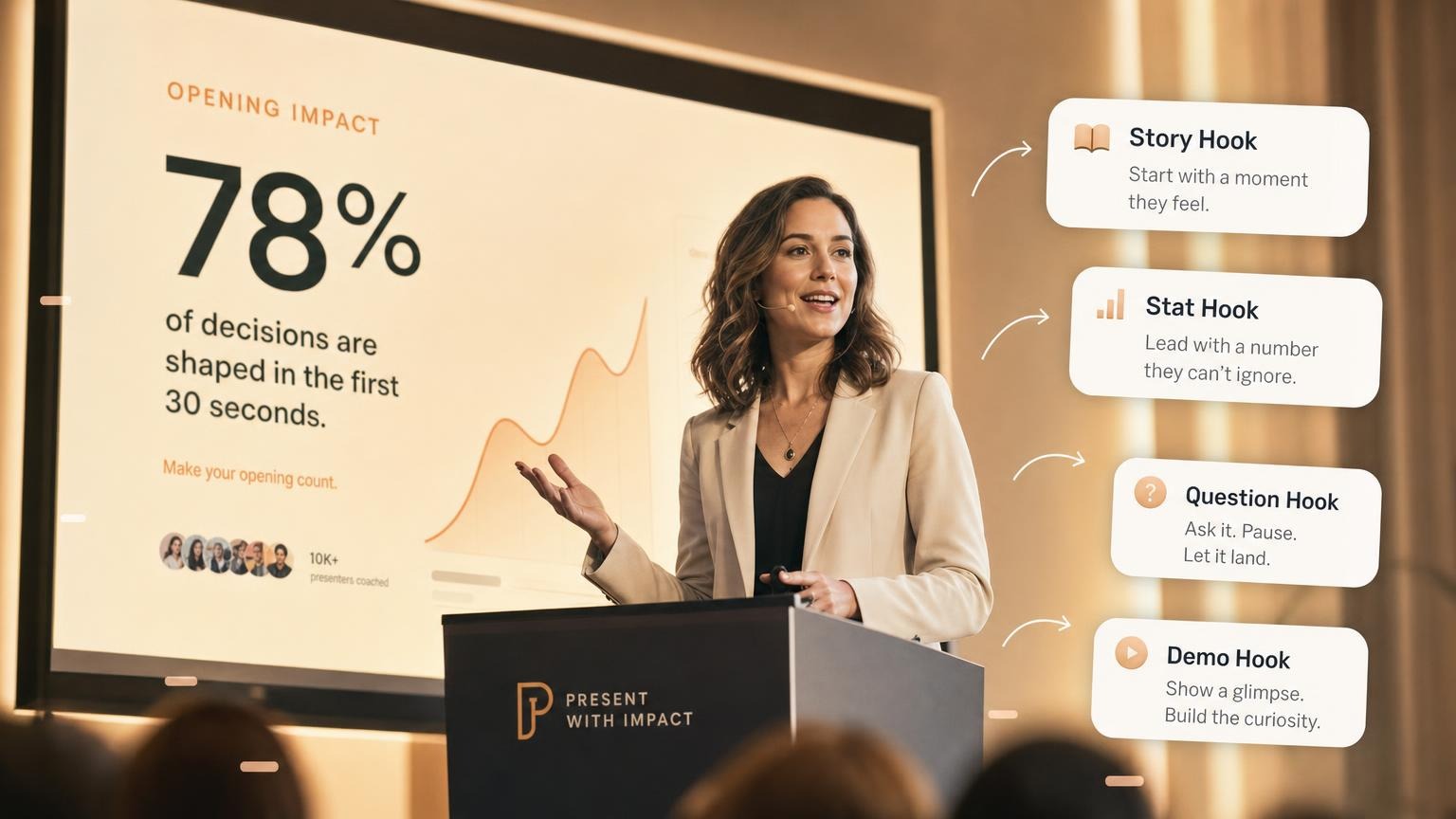
A presentation hook, also called an attention grabber, is the first thing you say: one story, number, question, quote, claim, joke or demonstration that gives the room a reason to listen. It takes 15 to 30 seconds, and it comes before your name, your title slide and your agenda.
To start a presentation, say the hook, say why it matters to this audience, then introduce yourself in one line. Below are more than 70 opening lines you can copy, grouped by hook type and by situation: class, sales pitch, pitch deck, team meeting, conference and job interview.
How to read the examples:
- Lines that name a source use real numbers. Each number was checked against its source on October 2, 2026. Check it again before you present.
- Lines with [brackets] are templates. Fill them with your own true details.
- Story lines about a customer, a manager or a team are models. Tell your own version. Do not present an invented story or number as fact.
What makes a presentation hook work
A good hook does three jobs at once:
- Signals relevance. Your audience hears why this talk matters to them.
- Creates tension. A gap, surprise, or unanswered question pulls them into the next slide.
- Sets the frame. Your deck resolves what the hook opened.
A hook that only describes the topic loses the room. Name a detail that sparks curiosity, concern, recognition, or disbelief.
| Weak opener | Strong opener |
|---|---|
| "Today I am going to talk about our onboarding flow." | "[N] out of 10 new users never see our second screen. Here is the first one." |
| "My presentation is about the planet Venus." | "On Venus, a day lasts longer than a year." |
| "Thanks for having me. A bit about our company first." | "You told us reports take your team two days a month. Here is the same report in ten minutes." |
The hook is only the opening. For structure, pacing, and delivery, see What Makes a Good Presentation.
How to start a presentation in the first 60 seconds
Many talks lose the room on slide one because the opener repeats the title or starts with "Today I'm going to talk about…" That is an agenda. Use this order instead.
| Step | Time | What you say |
|---|---|---|
| 1. Hook | 0 to 20 seconds | One story, number, question, quote, claim, joke or demo |
| 2. Why it matters | 20 to 35 seconds | "This matters to you because [consequence for this room]." |
| 3. Who you are | 35 to 45 seconds | "I'm [name]. I [one fact that earns you the right to speak on this]." |
| 4. The plan | 45 to 60 seconds | "In the next [N] minutes you get [three things]. Then I need [decision or action]." |
Here is the full opening as a script you can copy and fill in:
HOOK:  Last quarter we lost our second-biggest customer over one invoice email.
WHY:   Every team in this room sends emails like that one.
YOU:   I'm [name]. I run customer success, and I read every cancellation note from this year.
PLAN:  In the next 10 minutes: what the notes say, the three fixes,
       and the one decision I need from you today.
Adjust the opening to the length and the format of the talk:
- A 2 to 5 minute talk. Use a one-sentence hook and skip step 4. You do not have time for a roadmap.
- A 10 to 20 minute talk. Use all four steps. To plan the rest, see how many slides per minute and the 10/20/30 rule.
- An online meeting. Do the sound check before the meeting starts. Your first words on the recording are the hook, not "Can you hear me?"
- A greeting. A short "Good morning" before the hook is fine. Keep the thanks, the long bio, and the agenda for after it.
Memorize the hook word for word. It is the one part of the talk that is worth memorizing, because it carries you through the most nervous 20 seconds.
Four types of opening hooks
Four types do most of the work: story, stat, question, and demo. Three more (quote, bold claim, and humor) are in the next section.
Pick one per talk. Stack several in the first minute and you blur the opening.
| Hook type | Best for | Risk if overused |
|---|---|---|
| Story | Keynotes, pitches, training | Runs long without a point |
| Stat | Business updates, research talks | Dry numbers without context |
| Question | Classrooms, workshops, sales discovery | Fake when rhetorical |
| Demo | Product launches, technical talks | You need a backup slide or the demo fails |
Story hook
Open with a short scene: one person, one moment, one detail your audience recognizes. End the story on a turn that connects to your main point.
Template: "Last [timeframe], [person] [did something familiar]. Then [surprising turn]. That is why [your topic] matters."
Example: "Last quarter, our biggest customer almost churned over a billing email nobody on the product team had read. One sentence in the footer nearly cost us the account. That is why we rebuilt onboarding around clarity, not features."
More story hooks to copy:
- "Three years ago I read 42 slides to a room of twelve people. Nobody asked a question. This talk is what I changed after that day."
- "On Tuesday at 2 a.m. our checkout page went down. Nobody noticed until 9. I want to talk about those seven hours."
- "My first manager gave me one piece of feedback in two years. It was four words long, and it changed how I work."
- "In 1928, Alexander Fleming came back from a holiday and found mold on a dish of bacteria he had left out. The bacteria around the mold had stopped growing. That dish led to penicillin." (Source: Science Museum.)
- "It was [day and time]. [Person] was [doing something ordinary]. Then [the thing that went wrong]."
Stat hook
Lead with one number that contradicts what the room assumes. Name the source. Translate the stat into a human consequence in the next sentence.
Template: "[X]% of [group] [unexpected outcome], according to [source]. That means [concrete implication for this audience]."
Example: "6sense's 2025 buyer research says B2B buyers first contact a seller about 61% of the way through their buying journey. That means your deck is not introducing you. It is answering the last questions of a buyer who is already past the halfway point." (Source: 6sense Buyer Experience Report 2025.)
More stat hooks to copy. Every number here is real and has a source:
- "Gallup puts global employee engagement at 20% for 2025. In a team of ten, that is two people." (Source: Gallup State of the Global Workplace.)
- "Microsoft's 2025 Work Trend Index found that heavy Microsoft 365 users are interrupted every 2 minutes during core work hours by a meeting, an email or a chat. Over the full day, that adds up to 275 interruptions." (Source: Microsoft Work Trend Index 2025. The figure is for the top 20% of users by messages received.)
- "Nearly half of US teens say they are online almost constantly. A decade ago it was 24%." (Source: Pew Research Center, 2024.)
- "In 2022, the share of adults who sleep less than 7 hours ran from 30% in Vermont, the best state, to 46% in Hawaii." (Source: CDC.)
- "A day on Venus lasts 243 Earth days. A year lasts 225. On Venus, the year ends before the day does." (Source: NASA.)
- "[N] out of [total] [people in your company or class] [did something]. I counted."
The last line is the strongest. A number from your own inbox, support queue, or class survey beats a famous one, because nobody in the room has heard it.
Question hook
Ask a question your audience can answer in three seconds. Follow with a claim that reframes their guess.
Template: "What would you guess is [surprising metric or cause]? Most teams say [common answer]. The data says [your angle]."
Example: "What do you think loses us more deals: price or silence? Most reps say price. In our last [N] lost deals, [M] ended with an email nobody answered."
More question hooks to copy:
- "By a show of hands, who sat in a meeting this week that could have been an email?"
- "How many browser tabs do you have open right now?"
- "When did a slide last change your mind?"
- "If our biggest customer left tomorrow, how many days would pass before we noticed?"
- "What would you do with one extra hour every workday?"
- "Which of these two headlines is real?" Show both, then reveal.
- "How many of you have [common experience]? Keep your hand up if [the less comfortable version]."
Wait for the answer. A question you answer yourself in the same breath is a statement with a question mark.
A "what if" or "imagine" opener is a question hook in scenario form. It puts the audience inside a situation instead of asking for a show of hands:
- "What if every new hire could do their first real task on day one?"
- "Imagine you open your inbox on Monday and there are four emails in it, not ninety."
- "Imagine it is one year from today and this project worked. What is the first thing you notice?"
- "What if [the thing your audience accepts as normal] stopped tomorrow?"
Keep the scenario to one or two sentences. Then say how your talk gets the room there.
Demo hook
Show the outcome before the explanation. A screenshot, prop, before/after, or live product moment beats three bullets about "innovation."
Template: "Before I explain how this works, watch what happens when [user action]." Then show the result.
Example: "Before I walk through the architecture, here is what an analyst sees when fraud spikes." Show the alert screen, pause, then explain.
More demo hooks to copy:
- Hold up your phone. "Everything our customer needs is three taps away. Count them with me."
- Put a 40-row spreadsheet on screen and say nothing for five seconds. "This is what our customers see when they log in."
- Start a timer on screen. "By the time this reaches zero, [event] will have happened [N] times."
- Play ten seconds of a real support call, with permission. "That is what Monday sounds like."
- Show the before and the after side by side. "Same data. One of these got approved."
- Hand an object to the front row. "Pass this back. In a minute I will tell you what it cost us."
Keep a screenshot of the result on the next slide. If the live demo fails, you click once and continue.
Three more hook types: quote, bold claim and humor
These three work in the right room and fail in the wrong one. Read the risk before you pick.
| Hook type | Best for | Risk |
|---|---|---|
| Quote | Ceremonies, talks about a person or an idea | The audience thinks about the famous person, not about you |
| Bold claim | Strategy talks, team meetings, debates | You must prove it in the next two minutes |
| Humor | Rooms that know you, slots before lunch or late in the day | A joke about a person in the room, or one with no link to the topic |
Quote hook
A quote works when it is short, unexpected, and correctly attributed. Toastmasters lists famous quotations among the openers to avoid, because they move attention from you to someone else (Toastmasters Magazine, November 2025).
The fix: quote someone the room does not expect, such as your customer, your user, or a student.
Template: "Last week a [customer / user / new hire] told me: '[their exact words].' I want to spend ten minutes on that sentence."
Quote hooks to copy:
- "'Plans are worthless, but planning is everything.' Dwight D. Eisenhower said that in 1957. So here is our plan, and here are the three ways it will break." (Source: Eisenhower Presidential Library.)
- "In 1657, Blaise Pascal apologized for a long letter. He wrote that he did not have the time to make it shorter. I took the time. This talk has six slides." (Source: Quote Investigator.)
- "A customer wrote this in a support ticket on Monday: '[one sentence, word for word].' Nothing I say today is as clear as that."
- "My [daughter / student / newest hire] asked me one question about this project: '[the question].' I could not answer it. Now I can."
Check every famous quote before you use it. Many popular ones are attributed to the wrong person.
Bold claim hook
State an opinion the room does not expect, then prove it. Only make a claim you can defend with the next two slides.
Template: "Most people think [common belief]. I think [the opposite], and I have [N] minutes to prove it."
Bold claim hooks to copy:
- "Half of the slides in this deck should have been a document. I will show you which half."
- "We do not have a traffic problem. We have a checkout problem."
- "We will miss the March date unless we cut one feature today."
- "The best thing we shipped this year was a feature we deleted."
- "You do not need another tool. You need one fewer."
- "What you learned about [topic] in school is a simplification. Today you will see where it breaks."
Humor hook
Joke about yourself or the situation everyone shares. Never joke about a person in the room, and tie the joke to your topic.
Prepare the next line for the case that nobody laughs. Say it without a pause and continue.
Humor hooks to copy:
- "I know I am the last thing between you and lunch, so I cut ten slides. You are welcome."
- "I was asked to keep this short. My first draft had 60 slides, so we were both lucky."
- "This is a talk about spreadsheets. It will be the best spreadsheet talk you hear today, mostly because it is the only one."
- "My family thinks my job is sending emails. Today I will try to prove there is a second thing."
- "Raise your hand if you have ever read the full terms and conditions. Nobody? Good. That is my topic."
- "I picked this topic because nobody else wanted it. Give me five minutes to show you they were wrong."
Sales presentation hook examples
Sales hooks should name pain, stakes, or money within two sentences. Skip the company logo and mission statement on slide one.
| Hook type | Example opener | Why it works |
|---|---|---|
| Story | "Last month one of your reps spent an afternoon building a deck. The prospect never opened it." | Names wasted time the buyer already feels |
| Stat | "6sense's 2025 research says buyers first contact a seller about 61% of the way through their buying journey. So I will skip our company history and answer the questions you still have." | A real number, then a promise to respect their time |
| Your number | "You told us [N] hours a week go to [task]. Across [team size] people, that is [total] hours a month." | The buyer's own number beats any industry figure |
| Question | "How many of your reps reuse the same deck for every vertical?" Pause. "Your buyers can tell." | Reps recognize themselves |
| Demo | Show a cluttered slide, then your cleaned one-slide summary. "Same data. Different decision." | Visual proof before the pitch |
| Bold claim | "You do not need another tool. You need one fewer." | Unexpected from a vendor, so they listen for the reason |
Pair a strong opener with a deck built for that buyer. GenPPT can start from the buyer's brief as a PDF, a Word document, or a link, so the outline is drafted from their material and not from a generic template.
Classroom presentation hook examples
Classroom hooks run on curiosity and participation. Students tune out when slide one is a table of contents.
| Hook type | Example opener | Why it works |
|---|---|---|
| Story | "In 1928, Alexander Fleming came back from a holiday and found mold on a dish of bacteria. The bacteria around the mold had stopped growing. That accident became penicillin." | Turns abstract science into a story |
| Stat | "A day on Venus lasts 243 Earth days. A year lasts 225. So your birthday comes around before the day is over." | A real number that sounds wrong |
| Stat | "Nearly half of US teens say they are online almost constantly. Look left, look right." | Links the data to the people in the room |
| Question | "Raise your hand if you think hot water can freeze faster than cold water." Follow with the Mpemba effect. | Gets hands up, and the answer is still argued |
| Demo | Hold up a flat sheet of paper and a crumpled one. "Same paper, same weight. Which lands first?" Drop them. | They remember the drop |
| Bold claim | "By the end of this presentation, you will disagree with one sentence in our textbook." | Makes them listen for the sentence |
Sources: Science Museum for penicillin, NASA for Venus, and Pew Research Center for teens online.
The Mpemba effect is named after Erasto Mpemba, a Tanzanian student who saw hot ice cream mix freeze before cold mix in 1963. Physicists still dispute it, so present it as an open question.
Opening lines for a student class presentation
If you are the student, not the teacher, these lines work for a graded 5 to 10 minute presentation:
- "Before I start, guess: how long is one day on Venus?" Take two answers, then give the number.
- "I asked [N] people in our grade [your question]. [M] of them said [answer]."
- "You used [everyday thing] this morning. Here is what happens inside it."
- "This is the one thing about [topic] that our textbook leaves out."
- "Three weeks ago I knew nothing about [topic]. Here is the fact that made me care."
Do not open with "Hi, my name is [name] and my topic is [topic]." Your teacher knows both. Say the hook, then your name.
Need a topic before you write the hook? Start with unique college presentation topics and pick an angle your classmates have not heard yet.
Pitch deck hook examples
Investor and startup hooks compress tension fast. Lead with a problem worth solving.
DocSend's pitch deck research reports that investors spend less than 3 minutes on a deck (Dropbox DocSend). The problem has to land on the first slides.
| Hook type | Example opener | Why it works |
|---|---|---|
| Story | "My cofounder watched her mother miss three medication doses in one week because the pill bottle label was unreadable." | Personal stakes before market size |
| Stat | "$[X] billion is spent on [category] every year, and [Y]% of it still runs on spreadsheets and email. Source: [report name]." | Big market, clear inefficiency, and a source investors can check |
| Question | "What breaks first when a team scales from 10 to 100 people?" Pause. "Context. That is the problem we sell." | Founders nod before you show the product |
| Demo | Show the broken workflow in 10 seconds, then your product fixing it. "That manual step is what we eliminate." | Proof before the TAM slide |
| Bold claim | "[Category] software is priced per seat. We think that is the reason teams stop using it." | Shows a point of view on the market |
Investors check market numbers. Use a figure you can source, and put the source on the slide.
See how funded decks open in our Shark Tank pitch deck examples and in the full Airbnb pitch deck. Slide one is a problem statement more often than a logo wall.
Team meeting hook examples
In a team meeting, the hook is usually the decision. Your colleagues already know you, so skip the introduction and say what you need from them.
| Hook type | Example opener | Why it works |
|---|---|---|
| Bold claim | "We will miss the March date unless we cut one feature today. I have three candidates." | States the decision the meeting exists for |
| Stat | "Microsoft's 2025 Work Trend Index found heavy Microsoft 365 users are interrupted every 2 minutes during core work hours. So this update is one slide and one question." | A real number that earns you a short meeting |
| Your number | "We closed [N] tickets last sprint. [M] of them were the same bug." | A number from your own tracker that nobody can argue with |
| Story | "On Tuesday a customer emailed support three times about one button. Here is the button." | Small, concrete, and it sets up the fix |
| Question | "What is the one thing blocking you this week that I can remove in the next ten minutes?" | Turns a status update into help |
| Humor | "Good news: this meeting has one slide. Bad news: it is the budget." | Lowers the tension before a hard topic |
Conference talk hook examples
A conference audience does not know you and has a phone in hand. The hook must work for a stranger in row 20.
| Hook type | Example opener | Why it works |
|---|---|---|
| Story | "Two years ago my demo crashed in the first minute of a talk like this one. Today is about what we rebuilt." | An admitted failure earns trust fast |
| Stat | "Gallup puts global employee engagement at 20% for 2025. In a room of 200, that is 40 of us." | A real number scaled to the room |
| Question | "Raise your hand if you have shipped something on a Friday afternoon. Keep it up if you regretted it." | A two-step show of hands gets a laugh and a confession |
| Bold claim | "Most of what our industry calls best practice is a habit nobody has tested." | Picks a fight that the talk must then win |
| Demo | Put one photo on screen and say nothing for five seconds. Then: "This is the cable that took our service down for nine hours." | Silence makes a large room look up |
A well-known example: Jamie Oliver opened his TED2010 talk by telling the audience that four Americans would die from the food they eat during the 18 minutes he was about to speak. It is a stat hook scaled to the length of the talk.
Job interview presentation hook examples
In an interview presentation, the panel wants to see how you think. Open with your answer, then show the work.
| Hook type | Example opener | Why it works |
|---|---|---|
| Bold claim | "You asked for a 90-day plan. I will start with the one decision I would make in week one." | Shows judgment before detail |
| Your number | "In my last role I took [metric] from [X] to [Y] in [timeframe]. Here is how I would do the same here." | Proof first, method second |
| Story | "The first report I sent in my last job had an error on page one. This is the checklist I built that week." | Shows how you react to a mistake |
| Question | "Six months from now, what would make you say this hire was the right one? I built this presentation around my best guess." | Shows you thought about their goal, not only your resume |
| Demo | Show one annotated screenshot of their product. "I spent an hour as your customer yesterday. Here is what I saw." | Proves you did the homework |
Use only numbers from your own work that you can explain when the panel asks a follow-up question.
Opening lines to avoid
These openers are common, and each one spends your first seconds on nothing.
| Weak opener | Why it fails | Say this instead |
|---|---|---|
| "Today I am going to talk about…" | The title slide already said it | The hook, then the topic |
| "Can everyone hear me?" | Your first words are a tech check | Test the sound before you start |
| "Sorry, I did not have much time to prepare." | It tells the room to expect less | Nothing about your preparation |
| "Let me start by introducing myself." | The room does not yet know why it should care | One line about you, after the hook |
| "The dictionary defines [topic] as…" | Everyone has heard this opener | Your own one-sentence definition |
| A joke with no link to the topic | The laugh, if it comes, leads nowhere | A joke about the topic or the situation |
A hook can also fail when it is too good for the talk. If you open with a dramatic story and the next slide is a product roadmap, the audience feels the gap. The rest of the deck must answer what the hook opened.
How to write your own hook
Use this checklist before you finalize slide one:
- Pick one hook type from story, stat, question, demo, quote, bold claim, or humor.
- Write the spoken line first, then design the slide to support it.
- Cut the throat-clearing. Delete "So, um," "Today we'll cover," and "Let me start by introducing myself."
- Check the handoff. Slide two should follow the hook as the next beat.
- Read it aloud. If you run past 30 seconds, shorten the story or swap hook types.
- Check the facts. Open the source for every number and quote. If you cannot find it, cut it.
When you build the deck in GenPPT, put the hook in your prompt. For example: "Quarterly review for the leadership team. Open with the story of the customer we almost lost over a billing email."
You can also start from a PDF, a Word document, a text file, images, or a link.
GenPPT researches the topic and drafts an outline. You approve the outline before any slide is generated, so you can check that slide one carries your hook.
Then you pick a visual concept, and the slides are ready in about 2 to 3 minutes. You edit slides in chat and export to PowerPoint (.pptx) or PDF.
Two limits to know. The slides are image-native designs, so charts are not linked to Excel. And you must verify every number and claim yourself, in the hook most of all.
There is no free plan. The trial costs $1 for 3 days of full access (card required). After that, it is $25 a month or $99 a year, with 20 decks per month and watermark-free .pptx and PDF export.
Deck ideas with the hook built in
Each idea below has its opening in the topic. Tap one to start that deck, then check the outline before you generate the slides.
No topic yet? Browse presentation ideas by audience first, or see how to create a PowerPoint with AI from a PDF or a brief.
- Quarterly sales review that opens with one lost deal and what it taught usCreate
- How penicillin was discovered by accident, for a science classCreate
- Product launch deck that opens with a customer storyCreate
- Investor pitch deck that opens with the customer problem, not the market sizeCreate
- Team update that opens with the one decision we need todayCreate
- Why a day on Venus is longer than its year, for a class presentationCreate
- My 90-day plan for a job interview presentationCreate
Frequently asked questions
What is a good hook for a presentation?
A good hook is one short story, number, question, quote, claim, joke, or demonstration that makes the audience want the next sentence. It takes 15 to 30 seconds and it is about the audience's problem, not about you. The rest of the talk must answer what the hook opened.
How do you start a presentation?
Say the hook first. Then say why it matters to this audience, give your name with one line about why you are the person to speak, and state the plan. A short "Good morning" before the hook is fine. The thanks, the long bio, and the agenda come after it.
What are examples of engaging hooks?
Try a customer story with a costly twist, one counterintuitive statistic with a source, a question the audience answers in their head, or the product outcome before you explain features. For example: "We will miss the March date unless we cut one feature today." Copy and adapt the lines and templates in this guide.
Should the hook be on slide one?
Yes, in most talks. Slide one supports what you say out loud instead of repeating the title. Some speakers use a blank or bold single-stat slide and deliver the hook while they speak.
How long should a presentation hook be?
Aim for 15 to 30 spoken seconds, two to four sentences. In a talk of 2 to 5 minutes, use one sentence. Keynotes can run longer when the narrative is the talk; business and classroom opens stay tighter.
Can I combine multiple hook types?
Pick one primary hook for the opening. You can weave a stat into a story, but lead with one device so the audience knows why they should keep listening.
What hook works best for sales decks?
Stat and demo hooks work in sales because they tie to money and proof fast. The strongest number is the buyer's own, from your discovery call. Use a story hook when the buyer's pain is emotional or operational, not only numeric.
Open with intent
Pick one hook type, write two sentences, read them aloud, then design slide one. The opening sets up everything that follows.
When the line is ready, build the deck around it. Put the hook in your prompt, approve the outline, and export to PowerPoint or PDF.