
A one-pager is a single page that sells one idea to one reader. It has six parts: a headline, the problem, your solution, proof, the details the reader needs to decide, and one call to action. Below are 10 one-pager examples, one for each common business use, plus a do and don't table.
You send a one-pager before or after a meeting, attach it to a cold email, or hand it out at an event. The reader should get the point in under a minute and know what to do next. If they need more, that is what the pitch deck, proposal or demo is for.
The 6 parts of a one-pager
From investor teasers to charity flyers, one-pagers use the same six blocks. The order can change and the labels can change. The blocks stay.
Tidewell
Smart water metering for apartment buildings
1Problem
Leaks go unseen until the bill.
2Solution
Clip-on meter, leak alerts per unit.
3140
buildings
$38K
MRR
Market: US multifamily water billing
Team: 3 founders, ex-utility engineers
The ask: raising a $1.5M seed
5- 1
Headline
One line that says what it is and who it is for.
- 2
Problem
The pain your reader already feels, in their words.
- 3
Solution
What you do about it, in one or two short lines.
- 4
Proof
Two or three numbers, a logo row or a short quote.
- 5
Details
Only what the reader needs to decide: price, team, dates, the ask.
- 6
Call to action
One next step with a real email, link or phone number.
A quick test: cover the page with your hand, show only the headline and the call to action, and ask someone what you want from them. If they can say it back, the rest of the page is support. If they cannot, fix the headline first.
10 one-pager examples
Each card below is a full one-pager that GenPPT designed from a short brief in one run, in a 3:4 portrait page. The companies are fictional, so you can copy the structure without copying anyone's numbers. Tap a card to start your own one-pager from that brief.
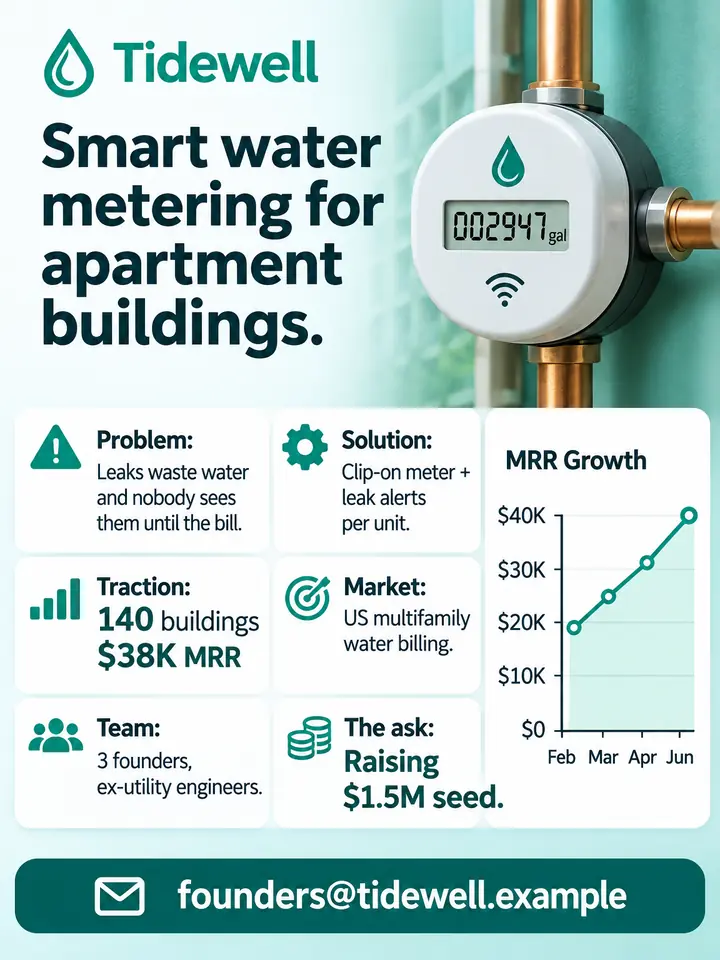 Investor one-pagerTidewell, smart water meters raising a seed roundMake one like this
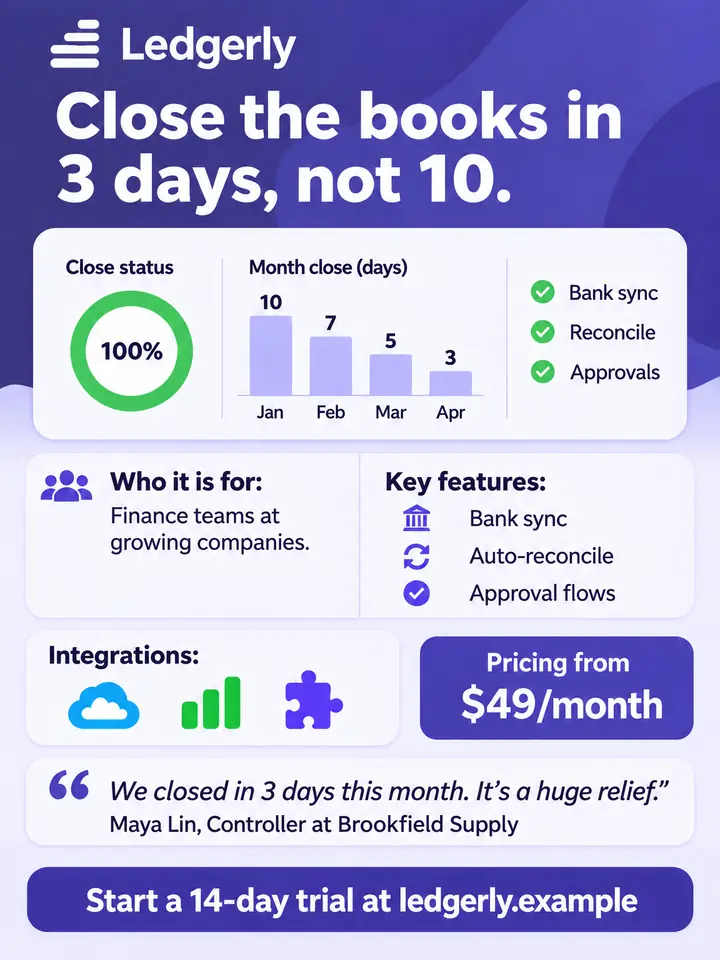 SaaS product one-pagerLedgerly, month-end close for small finance teamsMake one like this
 Marketing campaign one-pagerNorthfold Coffee spring cold brew launchMake one like this
 Project brief one-pagerBrightline warehouse scanning app rolloutMake one like this
 Sponsorship one-pagerRiverside Run 10K sponsor tiersMake one like this
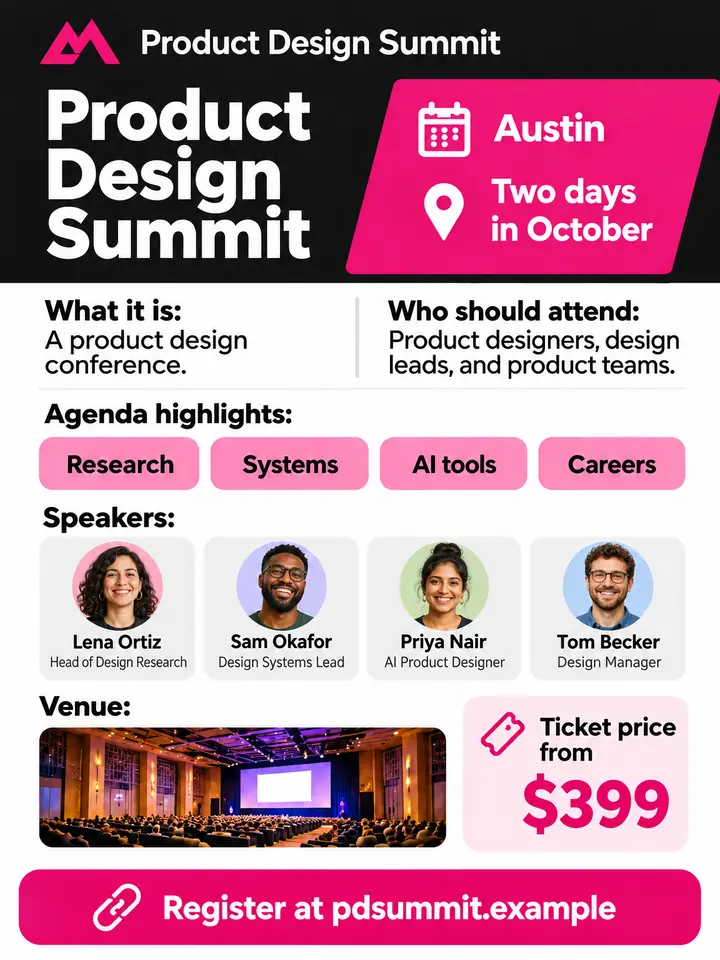 Event one-pagerProduct Design Summit in AustinMake one like this
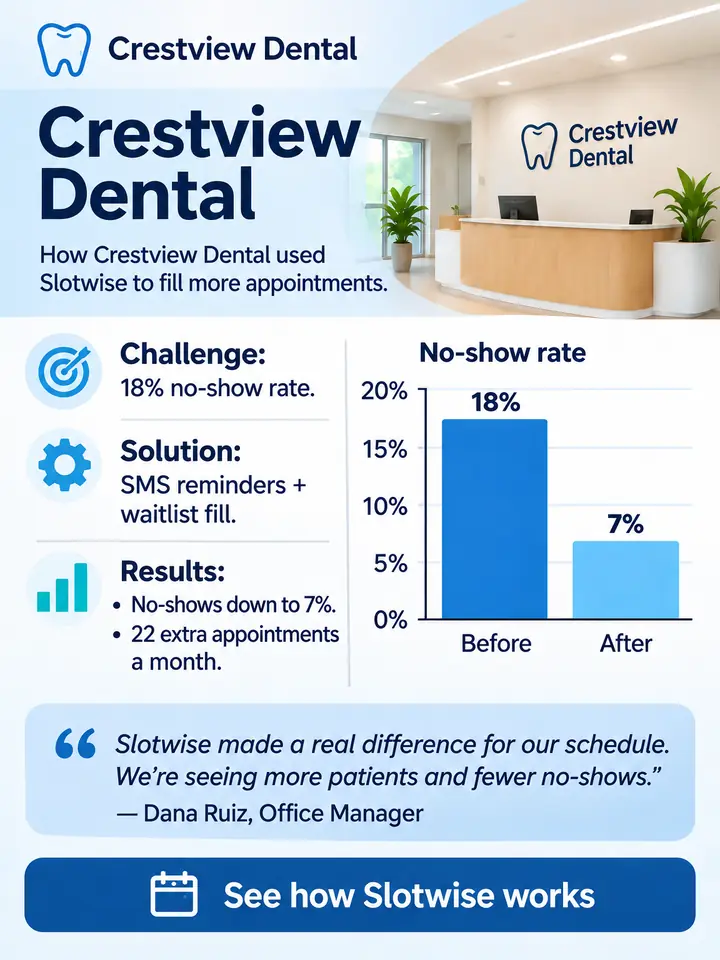 Case study one-pagerCrestview Dental cuts no-shows with SlotwiseMake one like this
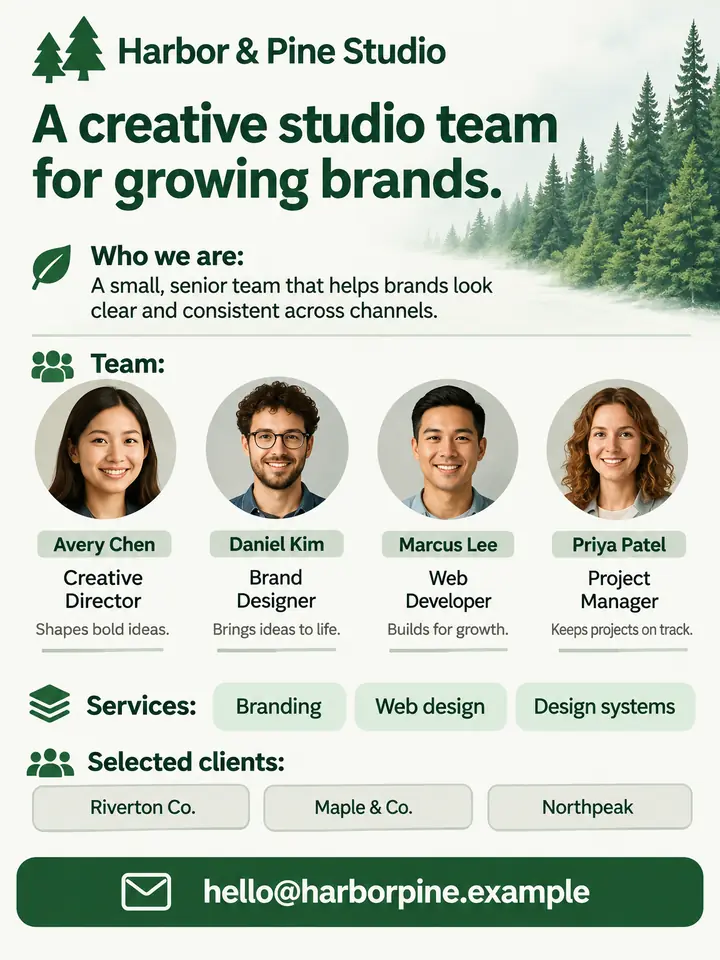 Team bio one-pagerHarbor & Pine, a 4-person design studioMake one like this
 Sales one-pagerFleetsure insurance for small delivery fleetsMake one like this
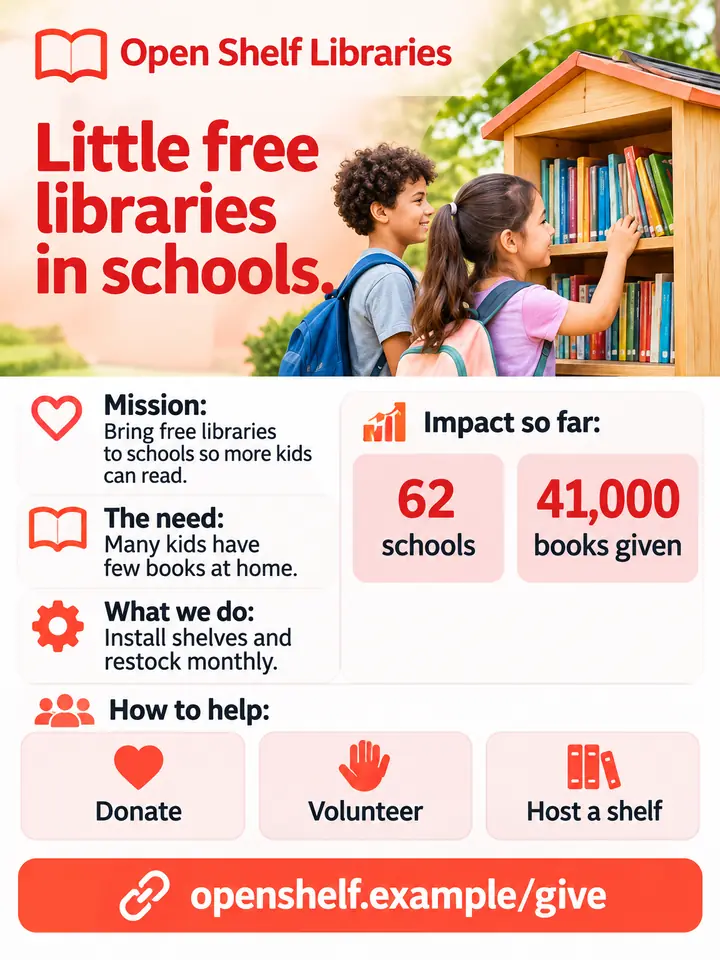 Nonprofit one-pagerOpen Shelf libraries in schoolsMake one like this
What each one-pager has to prove
The six parts stay the same. What changes is the reader and the one thing the page must prove to them. Use this table to pick which example to copy.
| One-pager type | Who reads it | What it must prove | Proof block in the example |
|---|---|---|---|
| Investor | Angels, seed funds | The business is growing and the ask is clear | 140 buildings, $38K MRR, $1.5M seed |
| SaaS product | Buyers and their boss | It saves time on a job they already do | Close in 3 days instead of 10, from $49/month |
| Marketing campaign | Brand team, agency, sales | Everyone knows the goal, dates and budget | 20,000 sample cans, 6-week timeline, $85K |
| Project brief | Project team and sponsors | Scope, owners and risks are agreed | In and out of scope, owner table, risk box |
| Sponsorship | Local businesses, brand managers | The audience is worth paying to reach | 3,000 runners, three priced tiers |
| Event | Attendees and their managers | The day is worth the ticket and the time | Four tracks, named speakers, $399 ticket |
| Case study | Prospects like the customer | Someone like them got a result | No-shows from 18% to 7% |
| Team bio | Clients picking a vendor | Real people with the right roles will do the work | Four named people with roles |
| Sales | A buyer comparing quotes | The offer is clear and fairly priced | Price per van in a three-row table |
| Nonprofit | Donors and volunteers | The money turns into visible impact | 62 schools, 41,000 books given |
All numbers in the table come from the fictional examples above.
What is a one-pager?
A one-pager is a short document that fits one side of one page, made to explain an idea, offer or project fast. Startups send them to investors, sales teams send them to buyers, project leads send them to stakeholders, and nonprofits send them to donors. Other names you will see: fact sheet, sell sheet, product sheet, company overview, investor teaser and executive summary.
Most one-pagers are a US Letter (8.5 x 11 inches) or A4 portrait page, shared as a PDF. Some teams make it a single 16:9 slide instead, so it drops straight into a deck. Pick the format your reader will open: a PDF for email, a slide for a meeting.
A one-pager is not a pitch deck and not a proposal. The deck tells the full story in 10 to 15 slides, and the proposal has the terms. The one-pager is the short version that gets you the meeting where the deck or proposal gets read. If you need the long version too, see our pitch deck structure guide and these sales deck examples.
One-pager do's and don'ts
| Do | Don't |
|---|---|
| Write a headline that says what you do and for whom | Open with your company name and a slogan |
| Name one reader and write only for them | Try to serve investors, buyers and press on one page |
| Use two or three real numbers as proof | Fill the page with adjectives like "best-in-class" |
| Put each section in its own labeled box | Write paragraphs longer than three lines |
| Show one visual: the product, a chart or a photo | Use five small pictures nobody can read |
| End with one call to action and a real contact | List every channel you have |
| Leave white space between blocks | Shrink the font to make more text fit |
| Date it and update it when the numbers change | Send last quarter's numbers |
How to make a one-pager in 5 steps
- Pick the reader and the ask. Write one sentence: "After reading this, [reader] should [action]." Everything else on the page serves that sentence.
- Write the six blocks as plain text first. Headline, problem, solution, proof, details, call to action. Aim for one or two lines each.
- Cut until it fits. If a block needs more than three lines, it belongs in the deck or the proposal, not here.
- Pick one visual. The product screen for SaaS, a chart for an investor, a photo for an event or a nonprofit.
- Design, then read it on a phone. Many people will open the PDF on a small screen. If the headline and the call to action are hard to read there, make them bigger.
To skip the layout work, paste your six blocks into GenPPT and pick a portrait (3:4) or 16:9 page. That is how every example on this page was made. On paid plans you can also export an Editable PowerPoint file, sent by email, so you can change the text and numbers yourself. See what that file looks like in our Editable PowerPoint examples.
FAQ
What is a one-pager?
A one-pager is a one-page document that explains a business, product, project or cause fast. It usually has six parts: headline, problem, solution, proof, key details and a call to action. People use it to get a meeting, a sale, a sponsor or a donation.
What should a one-pager include?
Include a clear headline, the problem, your solution, two or three proof points, the details the reader needs to decide (price, dates, team or the ask) and one call to action with a real contact. Leave out anything the reader does not need to take that next step.
How long should a one-pager be?
One side of one page. In words, most good one-pagers stay short enough to scan in about a minute. If you need a second page, you need a different document, like a deck or a proposal.
What is the difference between a one-pager and a pitch deck?
A one-pager is one page that gets the reader interested. A pitch deck is 10 to 15 slides that tells the full story in a meeting or a follow-up. Founders often send the one-pager first and the deck after a reply.
What size is a one-pager?
Most one-pagers are US Letter (8.5 x 11 inches) or A4 (210 x 297 mm), portrait, saved as a PDF. A single 16:9 slide also works if the one-pager will sit inside a presentation.
Can I make a one-pager in PowerPoint or Google Slides?
Yes. In PowerPoint, set the slide size to Letter or A4 portrait under Design, then Slide Size. In Google Slides, go to File, then Page setup, and set a custom portrait size. Or let GenPPT design the page from your notes in a 3:4 portrait size, like the examples above.