
You send the deck after a good call. Then silence. The champion liked you. The VP never opened slide 4.
That is the real job of a sales deck. It has to work without you in the room, survive a forward to procurement, and still make one next step obvious.
Pitch.com's 2022 roundup of eight decks is useful as a mood board. It is thin on why each slide earns its keep. This guide keeps eight examples, then adds the slide order, a live vs leave-behind split, and the mistakes that stall deals.
What a sales deck has to do
A pitch deck asks for money. A sales deck asks for a purchase, a pilot, or a calendar hold.
Gong's 2024 deal research still shows the same pattern: longer cycles, more people on the thread, and more async review. Your deck is often the only artifact that travels.
Write for three readers:
- The user. Will this make Tuesday easier?
- The economic buyer. What is the payback window?
- The blocker. Security, legal, IT, procurement.
If a slide does not serve one of those three, delete it.
The 10-slide sales deck order
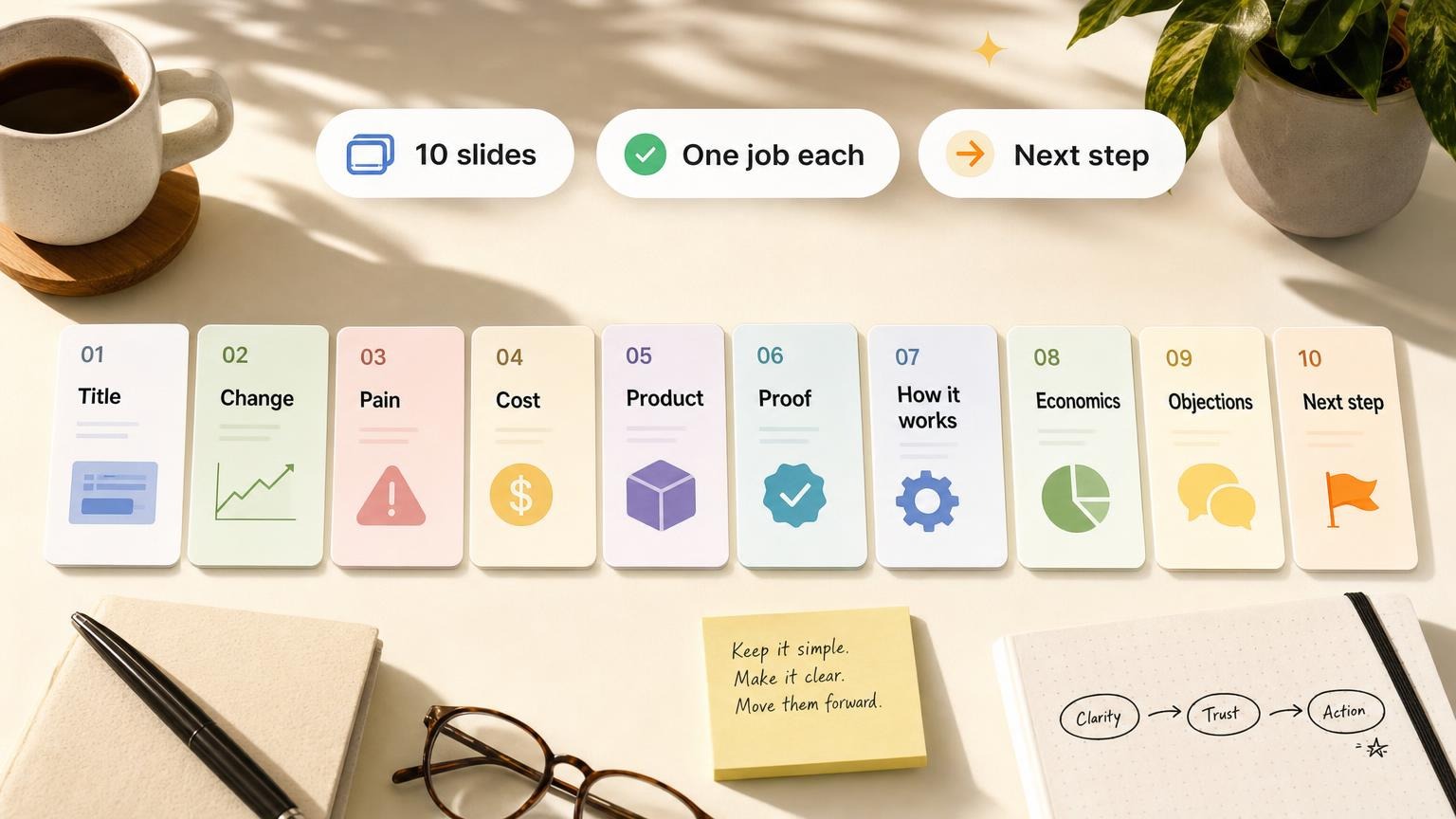
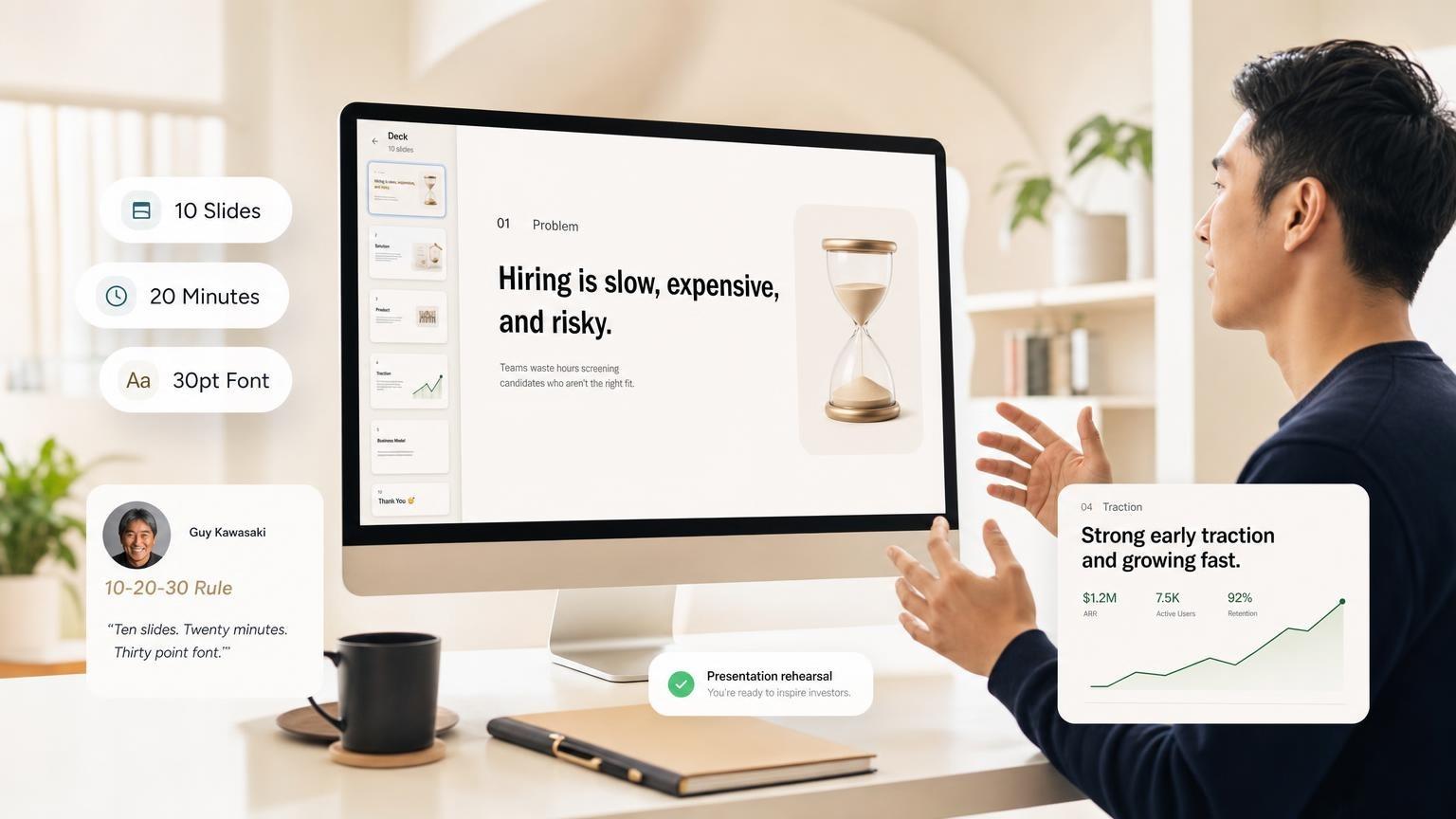
Guy Kawasaki's 10-20-30 rule is for investor rooms. Sales rooms need a similar cap, but a different sequence.
| Slide | Title | One job |
|---|---|---|
| 1 | Title + one-liner | Name the outcome, not the category |
| 2 | The change | What shifted in the buyer's market |
| 3 | The pain | Their week, in their words |
| 4 | Cost of inaction | Time, money, or risk if nothing changes |
| 5 | Product | How you remove that pain, in one visual |
| 6 | Proof | Logo, metric, quote. Prefer one strong number |
| 7 | How it works | 3 steps. Implementation, not feature dump |
| 8 | Economics | Price, ROI, or TCO vs status quo |
| 9 | Objections | Security, switching cost, "we already have X" |
| 10 | Next step | Pilot scope, mutual action plan, or date |
Appendix after that: security one-pager, detailed pricing, case study, integration list.
Ten slides for the meeting. Twenty is a leave-behind. Forty is a product tour nobody finishes.
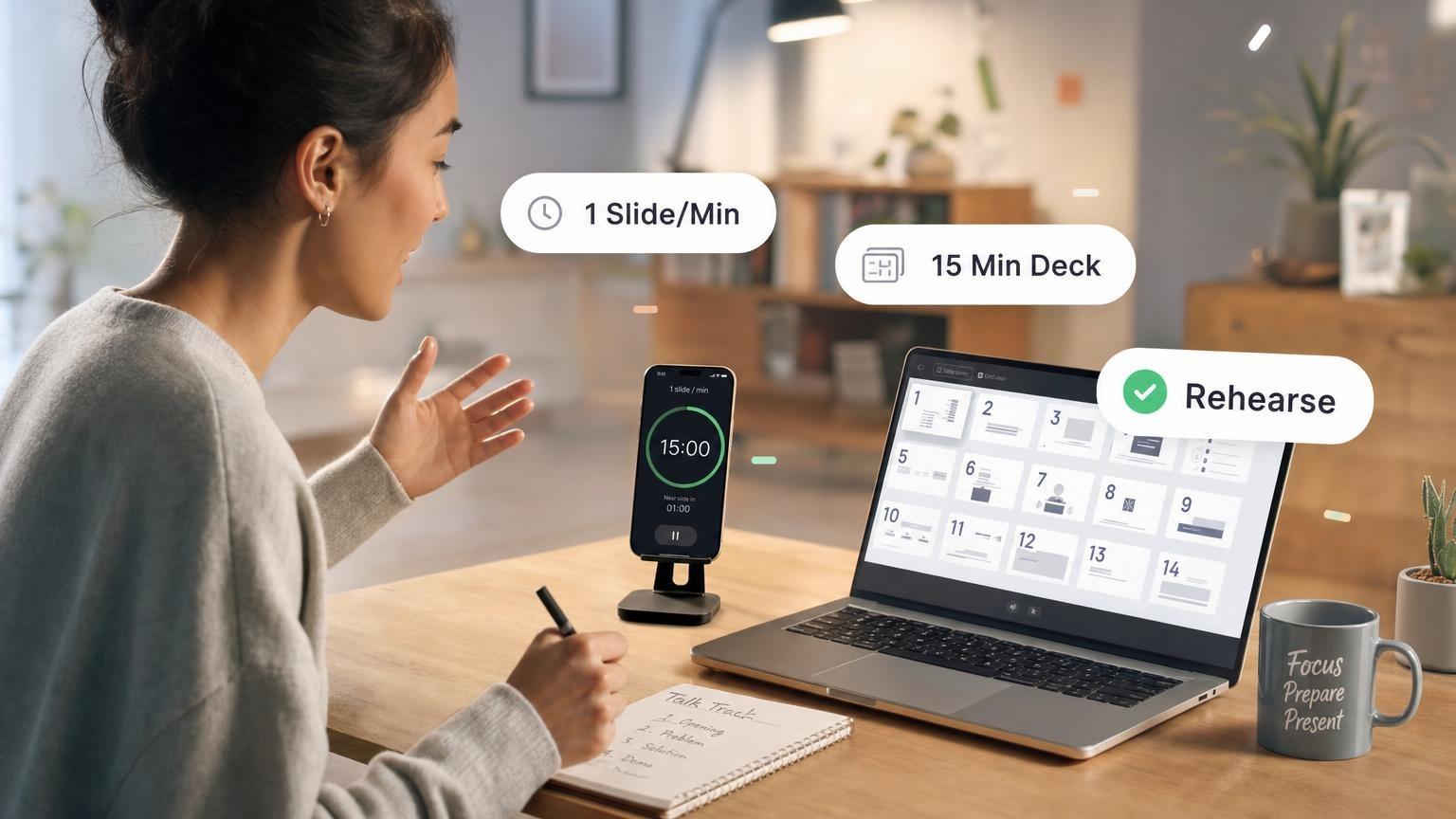
For how many slides fit a 20-minute call, see how many slides per minute.
8 sales deck examples and the move you can steal
These are public B2B patterns, not screenshots of Pitch's gallery. Steal the move, not the brand.
1. Sastrify: map the buying committee on one slide
Sastrify sells SaaS buying help. Their deck splits benefits for finance, procurement, and IT, then parks FAQs mid-deck so blockers get airtime before the close.
Steal this. One slide with three columns: user, economic buyer, IT. One sentence each. If you cannot fill a column, you do not know the deal.
2. Spendesk: lead with traction, then the product
Spendesk opens with growth and logos before the feature tour. New spend tools look risky. Social proof lowers the perceived switching cost.
Steal this. If you sell into finance, put logos and "used in X countries" before screenshots. If you sell a new category, reverse it: teach the change first.
3. ChartMogul: write the leave-behind as a document
ChartMogul's deck follows problem, solution, benefits in copy that works without a voiceover. That is a pre-read, not a stage deck.
Steal this. After the call, send a version with complete sentences. The live version should have 8-12 words per slide.
4. Zuora / Pocus: open on a market shift
Andy Raskin's "greatest sales deck" write-up of Zuora still gets copied because it starts with a world that already changed. Subscriptions were not a feature. They were the new default. Pocus used the same "shift" open for product-led sales.
Steal this. First content slide: "Buying used to work like X. It now works like Y." Then show that the old sales motion is the risk.
5. Oliva: let the visual match the offer
Oliva sells team workshops. Calm palette, motion on one slide, almost no chart junk. Design is the product preview.
Steal this. If you sell "calm," "speed," or "precision," the deck should look like that in 3 seconds. A chaotic wellness deck loses before slide 2.
6. Producter: quantify the problem, then testimonials
Producter sizes the pain in a number, then drops customer quotes. Stakes first, trust second.
Steal this. "PMs spend 11 hours a week in status meetings" beats "we help you be customer-driven." Then one named quote with a title.
7. Klima: show the product doing the job
Klima's B2B deck is mostly product-in-use. Climate tools die in abstraction. Screens of the workflow beat mission copy.
Steal this. Three sequential screens: before, during, after. Caption each with the user action, not the feature name.
8. Zuora (via Andy Raskin): name the shift, then the losers
Andy Raskin's write-up of Zuora's deck is still the cleanest public "shift" example. The deck does not open with a product shot. It opens with a world that already changed (subscription), then shows who still sells the old way.
Steal this. Slide 2: old world. Slide 3: new world. Slide 4: who is stuck. Product on 5. If you cannot name the shift in eight words, you do not have this structure yet.
Public sources for the eight patterns: Pitch's gallery write-up, Raskin's Zuora essay, and company sites. Steal the move. Do not scrape their art.
For investor decks instead of sales decks, start with the Airbnb pitch deck breakdown and how to sequence a seed deck.
Sales deck by deal type
| Deal | Open with | Proof | Ask |
|---|---|---|---|
| New logo | Market shift + cost of status quo | One peer logo in their industry | Pilot scope + date |
| Expansion / land-and-expand | Usage in the current seat | Their own numbers from the CSM | Extra seats or module |
| Competitive bake-off | Side-by-side on their must-haves | Switching plan, not a feature grid | Mutual evaluation checklist |
| RFP / procurement | Compliance and TCO | Security appendix, named references | Written next step with legal |
Do not send the new-logo deck into an RFP. The champion will look unprepared.
Pricing and ROI slides that survive finance
Three patterns. Pick one.
- Range. "$24-32k / year for 50 seats, billed annually." No fake precision.
- TCO vs status quo. "You already spend 1.4 FTE on this spreadsheet. We cost 0.3 FTE plus license."
- Payback. "Average payback 5 months on the last 12 logos in this segment."
Write the assumption under the number: discount rate, seat count, hours. Finance will ask. If Gong-style deal research is useful, use Gong's published revenue reports for cycle-length context. Do not invent a "2024 Gong stat" without a URL.
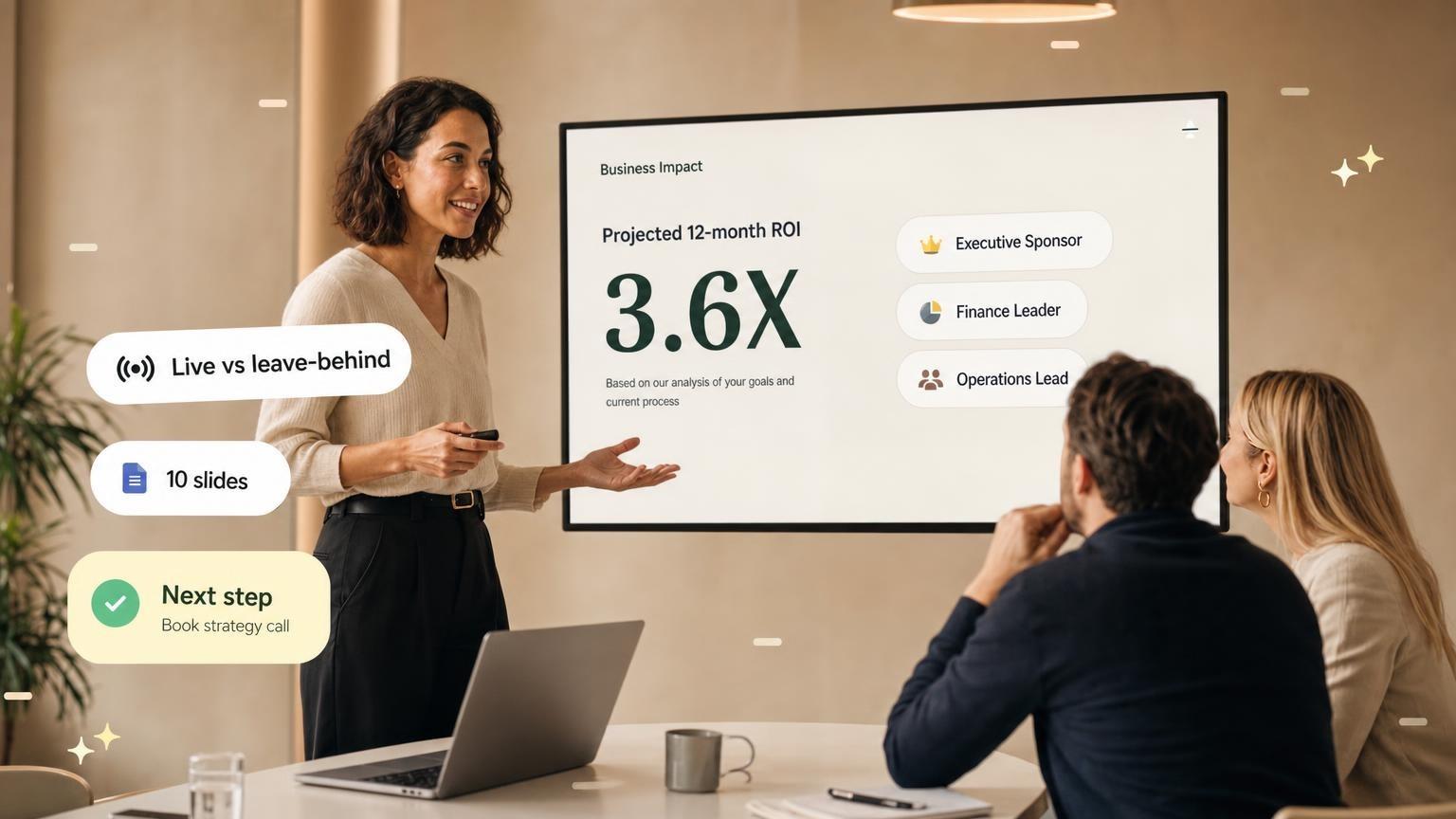
Live pitch vs leave-behind
| Live (Zoom / room) | Leave-behind (email) | |
|---|---|---|
| Words per slide | 8-15 | Full sentences |
| Charts | One number, huge | Source + footnote |
| Demo | You click the product | 3 annotated screenshots |
| Pricing | Ranges, not a rate card | Table + assumptions |
| Next step | Spoken, then on slide 10 | Calendar link + owners |
Never email the live deck. Champions cannot present sparse slides to a VP.
Record a 4-minute walkthrough if the champion has to sell for you. Keep the file name specific: Acme-Q3-pilot-overview.pptx, not Company-sales-deck-final-v7.pptx.
What to cut before you send
- Company history. Founded-in-2014 slides waste the first 90 seconds.
- Team photos unless they are the product. Services firms can keep one slide. SaaS usually cannot.
- Feature grids. Replace with one workflow.
- Stock photos of handshakes. They signal you had nothing to show.
- Six case studies. One that matches industry and company size beats a logo wall.
- Internal jargon. If procurement has to Google it, it dies in the thread.
Before export, click every slide in PowerPoint. Check contrast, truncated text, and that the next-step slide has a date and an owner.
Build the deck from the notes you already have
Paste the discovery call notes, the one-pager, and the three buyer titles into GenPPT. Lock the outline to this 10-slide order. Generate visuals after the story is true.
If you need a competitor slide inside a fundraising deck, use the competition slide guide. For design craft after structure, see how to make a good presentation.
A sales deck that closes is boring in a good way: one change, one pain, one proof, one ask.