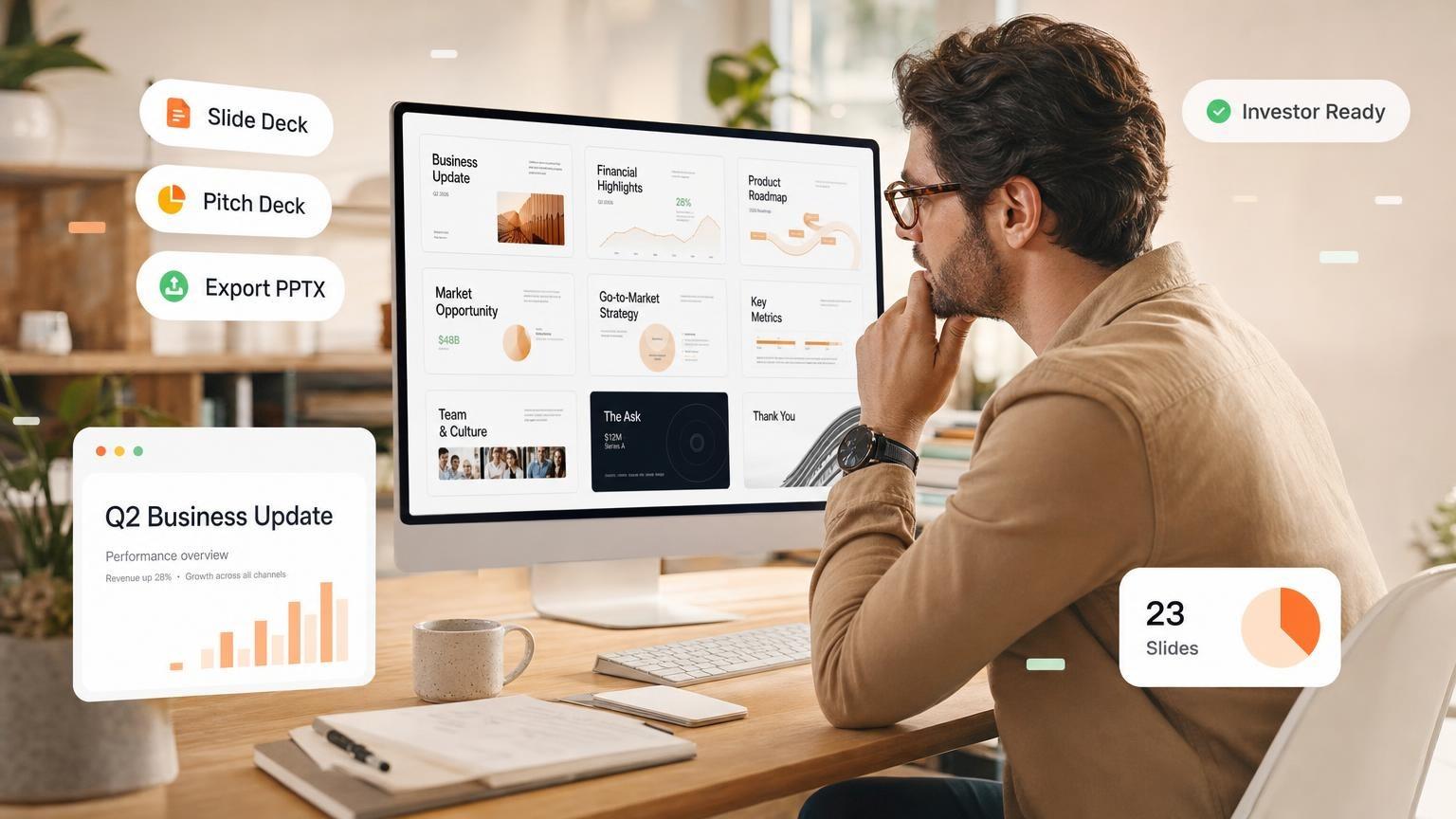

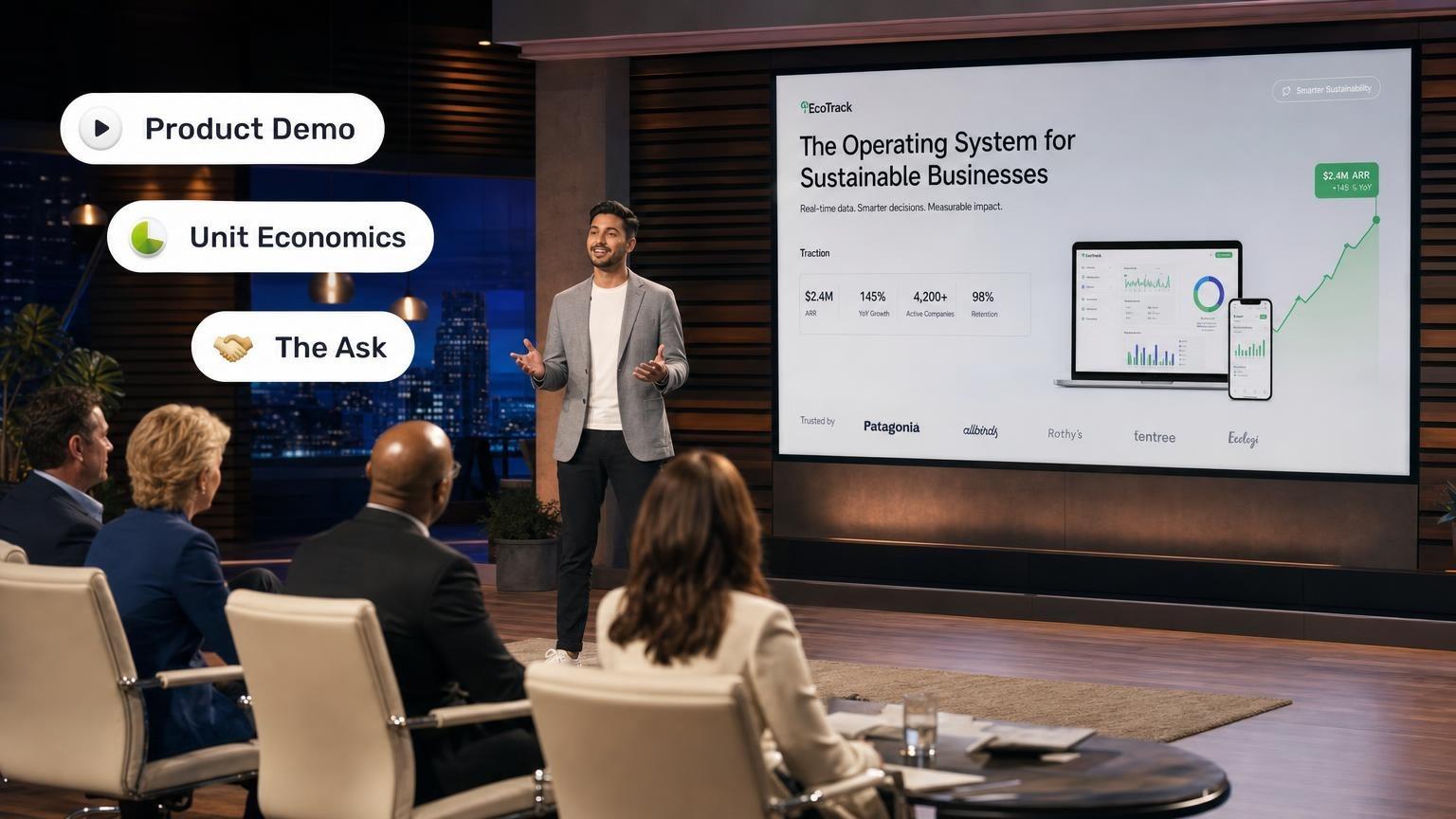
A Shark Tank presentation is a short pitch with six parts: a hook, the problem, a product demo, proof that people want it, the numbers, and the ask (money in exchange for a share of the company). For a class project or a pitch contest, plan 3 to 5 minutes and 6 to 8 slides.
The Shark Tank pitch deck examples on this page follow the same order. You get a slide-by-slide template with timing, a script to copy, product ideas for a class project, and four ABC Shark Tank pitches that closed deals. For original slides from famous startup decks, browse the GenPPT pitch deck library.
Shark Tank pitch vs investor pitch deck
On Shark Tank, a founder walks in, gives a short rehearsed opening pitch next to a product display, and then takes questions from five investors. Props and live demos do the work that slides do in a meeting room.
What you see on TV is an edit. A session of around 45 minutes is cut to about 11 minutes of airtime, according to the show's Wikipedia entry. The handshake is not final either. Kevin O'Leary has said that about 20% of on-air deals never close after due diligence.
A class project or pitch contest keeps the format and shrinks it: 3 to 5 minutes to pitch, a few minutes of questions, and slides in place of a TV set.
| Element | Shark Tank pitch | Classic VC pitch deck |
|---|---|---|
| Opening | Product demo or story hook | Cover + one-line value prop |
| Proof | Sales, profit, customers served | Traction, retention, pipeline |
| Visuals | Before/after, app screenshots, costumes | Product screenshots, charts |
| Close | Dollar ask + equity offer | Round size, use of funds, valuation |
| Length | About 45 minutes on set, about 11 on air | A meeting, then follow-up questions |
| Risk | Entertainment and editing | Partner meeting and diligence |
The overlap is what matters. If your slide deck cannot survive a Shark-style Q&A ("What's your margin?" "Why you?" "What do you need the money for?"), it is not ready for angels or seed funds.
The slide structure behind winning Shark Tank pitches
The four deals covered below map to six sections. You do not need six slides. You need six answers:
- Hook: What is this, and why should I care in 10 seconds?
- Problem: Who hurts, and how much?
- Solution / demo: Show the product working. Skip the bullet list.
- Traction: Revenue, units sold, growth, or social proof
- Economics: Margin, CAC, repeat purchase, or expansion plan
- Ask: How much money, for what equity, spent on what
Compare that sequence to Airbnb's 2009 pitch deck: problem slides, solution, validation, TAM, product screenshots, commission model, then the ask. Same spine, different room.
If you pitch real investors, the six answers grow into a longer deck. See pitch deck structure for the full 12-slide order.
Shark Tank presentation template for a 3 to 5 minute pitch
Use this outline for a class project, a pitch contest, or a practice run. It takes about 4 minutes at a normal pace. Each row is one slide.
| Slide | Time | What you say | What the slide shows |
|---|---|---|---|
| 1. Hook and ask | 0:00-0:20 | Your names, the product name, and the ask | Product name, logo, the ask |
| 2. Problem | 0:20-0:50 | Who has the problem and what it costs them | One photo or one number |
| 3. Demo | 0:50-1:50 | How it works, shown live | Prototype, short video, or 3 photos |
| 4. Customer | 1:50-2:15 | Who buys it first and how many of them exist | One customer profile |
| 5. Proof | 2:15-2:45 | Sales, pre-orders, survey results, or test results | One chart or one quote |
| 6. Money | 2:45-3:20 | Price, cost to make, profit per unit | Three numbers, large |
| 7. Competition | 3:20-3:40 | What people use now and why yours is better | Two-column comparison |
| 8. Ask and plan | 3:40-4:10 | The ask again, and what the money pays for | The ask plus 3 spending lines |
Adjust it to your time limit:
- 3 minutes: Merge slides 4 and 5 and cut slide 7. Six slides.
- 5 minutes: Give the demo 90 seconds and add a team slide before the final ask.
- Q&A: Keep one backup slide with your cost breakdown. Expect the first question to be about money.
This template moves at about 30 seconds per slide. That is faster than an investor meeting, and it works because each slide holds one point. For other lengths, see how many slides per minute.
GenPPT can draft this outline from one sentence about your product. You approve the outline, pick a visual concept, and the designed slides are ready in about 2 to 3 minutes.
How to set your ask
The ask has two numbers, and together they set a price on your company:
Company value = money asked ÷ equity offered
Ask for $50,000 for 10%, and you say the company is worth $500,000. The Sharks do this math in their heads, and your judges will too. Be ready to explain the value with sales or profit.
Here is how the ask moved in the four deals covered below:
| Company | First ask | Final deal | Value at the deal |
|---|---|---|---|
| Scrub Daddy | $100,000 for 10% | $200,000 for 20% | $1 million |
| Brightwheel | $400,000 for 4% | $600,000 for 6.67% | About $9 million |
| Ten Thirty One | $2 million for 10% | $2 million for 20% | $10 million |
| Simple Sugars | $100,000 for 10% | $100,000 for 33% | About $300,000 |
Every founder ended with less of the company than planned. For a class project, pick an ask you can defend with your sales estimate, and decide your lowest acceptable offer in advance.
Shark Tank pitch script template
Copy this skeleton and fill in the brackets. The timings match the template above.
HOOK (20 seconds)
Hi Sharks. I'm [name], and this is [teammate]. We are the founders of [product name].
We are seeking $[amount] for [percent]% of our company.

PROBLEM (30 seconds)
Have you ever [annoying situation]? [Who] deals with this [how often].
Today the options are [current option 1] and [current option 2]. Both [what is wrong with them].

SOLUTION AND DEMO (60 seconds)
That is why we made [product name]. It [what it does] so that [benefit].
Let me show you. [Do the demo. Say out loud what the audience sees.]

CUSTOMER AND PROOF (55 seconds)
Our first customers are [specific group]. We [sold to / surveyed / tested with] [number] of them.
[Result: units sold, people who said they would buy, or one customer quote.]

MONEY AND COMPETITION (55 seconds)
[Product name] costs $[cost] to make and sells for $[price]. That is $[profit] profit on each one.
We sell through [where]. People choose us over [competitor] because [one reason].

THE ASK (30 seconds)
With $[amount], we will [use 1], [use 2], and [use 3].
So, Sharks, who wants to [short line tied to your product]?
How to pitch like Shark Tank
The script is half of the pitch. The delivery is the other half.
- Memorize the first and the last line. Read nothing from the slides. Founders on the show pitch from memory.
- Demo early. If the product is an app or a service, show three screenshots or act out the before and after.
- Split a team pitch by section. One person opens and closes. One person does the demo. One person owns the numbers and answers money questions.
- Time it out loud. Reading in your head is faster than speaking. Cut words until you finish 15 seconds under the limit.
- Know your Sharks. Find out who judges and what each one cares about. Aim your numbers and your ask at them.
- Open strong. A question, a prop, or a short story works better than "Today we will talk about." See these presentation hook examples.
1. Scrub Daddy: one USP, then the numbers
Founder: Aaron Krause
Season: 4 (aired October 2012)
Ask: $100,000 for 10% equity
Deal: $200,000 for 20% equity (Lori Greiner)
Outcome: Scrub Daddy became one of the show's biggest success stories. Its Wikipedia entry cites more than $926 million in retail sales as of May 2023.
What the pitch did
Krause opened with the smiley sponge, then pivoted to the differentiator: the material is temperature reactive. Soft in warm water for gentle scrubbing; firm in cold water for tough messes. One product, one mechanical advantage, easy to repeat back.
The numbers came next. Episode recaps report more than $100,000 in sales in the first four months. Several Sharks made offers, and Greiner won by doubling both the money and the equity. The $1 million valuation did not change.
The day after the episode aired, Greiner and Krause sold 42,000 sponges on QVC in under seven minutes.
Slide / stage structure
| Section | What worked |
|---|---|
| Hook | Physical demo: sponge changing texture in water |
| USP slide | Single claim: temperature-reactive scrubbing |
| Traction | Early sales, reported as more than $100,000 in four months |
| Ask | $100,000 for 10%. Closed at $200,000 for 20% |
Lesson for your deck
Lead with demonstration. If you cannot demo live, use a 15-second video or a product photo sequence on one slide. Save brand personality for slide two.
For a startup deck that nails "one idea per slide," see the Dropbox pitch deck teardown: plain slides, product proof, simple ask.
2. Brightwheel: story first, data second
Founder: Dave Vasen
Season: 7 (2016)
Ask: $400,000 for 4% equity
Deal: $600,000 for 6.67% equity (Mark Cuban and Chris Sacca)
Product: Mobile app connecting daycares, teachers, and parents
What the pitch did
Vasen framed Brightwheel as a parent pain point the Sharks could relate to: "What did my kid do today?" He told the story of his own daughter starting preschool, then showed the app handling attendance, billing, messages to parents, and photo updates from a phone.
The parent pain point earned attention. The numbers earned the offers: the app was already in use at about 2,500 schools, and the company had raised a $2.2 million seed round.
Kevin O'Leary and Chris Sacca made offers. Vasen asked to bring in a second Shark, and Cuban and Sacca closed together at $300,000 each.
Slide / stage structure
| Section | What worked |
|---|---|
| Problem | Parents disconnected from daycare updates |
| Solution | App screens: check-in, photos, billing |
| Market | Childcare providers as B2B buyers, parents as beneficiaries |
| Traction | About 2,500 schools and a $2.2 million seed round |
| Ask | $400,000 for 4%. Closed at $600,000 for 6.67% |
Lesson for your deck
Use two-audience framing when your buyer and user differ (school admin buys, teacher uses, parent benefits). One slide per stakeholder beats a generic "market opportunity" funnel.
Brightwheel's B2B SaaS story rhymes with Buffer's 2011 seed deck: traction and paying users before vision.
3. Ten Thirty One Productions: show the experience, then the margin
Founder: Melissa Carbone
Season: 5 (aired October 2013)
Ask: $2,000,000 for 10% equity
Deal: $2,000,000 for 20% equity (Mark Cuban), reported as the largest deal in the show's history at that time
Business: Live horror experiences (Haunted Hayride, etc.)
What the pitch did
Carbone skipped "immersive entertainment." She brought the product into the room: a zombie actor at her side, then more performers in costume creeping up on the Sharks. The pitch was the product.
Then she flipped to operator metrics investors care about: $1.8M revenue in 17 nights on the LA Haunted Hayride, with $600K profit in that window. The plan was a New York hayride and a set of horror campouts on the West Coast.
Daymond John offered $2 million for 40%. Carbone countered at 20%, and Cuban took it. The company was acquired by Thirteenth Floor Entertainment Group in 2018.
Slide / stage structure
| Section | What worked |
|---|---|
| Experience hook | Live actors (proof of demand and production quality) |
| Traction | $1.8M revenue in 17 nights |
| Unit economics | $600K profit in the same 17 nights |
| Expansion | A New York hayride and West Coast campouts |
| Ask | $2 million for 10%. Closed at 20% |
Lesson for your deck
Experiential or consumer brands must answer whether the business repeats. Carbone answered with the profit from a 17-night run and a rollout plan.
If you are building a narrative-heavy deck, pair showmanship with the financial discipline in Brex's Series B deck: hard numbers after the hook.
4. Simple Sugars: founder story plus live product trial
Founder: Lani Lazzari (a teenager at the time; sources give her age as 18 or 19)
Season: 4 (aired March 2013)
Ask: $100,000 for 10% equity
Deal: $100,000 for 33% equity (Mark Cuban)
Product: All-natural skincare scrubs for sensitive skin
What the pitch did
Lazzari opened with a personal story (childhood eczema) that explained why she formulated the product herself. Stories do not close deals alone. She demonstrated the scrub on camera with Lori Greiner, so the Sharks judged the product and not only the story.
The numbers followed. Episode recaps report $55,000 in sales for the year to date and margins of about 75% to 80%.
Cuban asked for 33%, more than three times the equity she offered, and she accepted. HuffPost reported that sales passed $1 million within six weeks of the episode.
Slide / stage structure
| Section | What worked |
|---|---|
| Origin story | A real problem and a founder-built solution |
| Demo | Live product trial with a Shark on air |
| Differentiation | Simple ingredients vs. drugstore alternatives |
| Traction | Reported $55,000 in sales that year |
| Ask | $100,000 for 10%. Closed at 33% |
Lesson for your deck
Consumer products need third-party validation on the slide or in the room: retail POs, repeat purchase rate, or an influencer quote. Open with the founder story. Close with proof.
What failed: RoloDoc (and why structure beats buzzwords)
Not every Shark Tank pitch belongs in a "best of" list. RoloDoc (Season 5 premiere, September 2013) is the cautionary tale Mark Cuban called the worst pitch on the show.
The founders, brothers and doctors Richard and Albert Amini, asked for $50,000 for 20%. They described a "social network for doctors" but could not explain how it made money, how doctors would be verified, or what was social about it. The pitch was a stack of buzzwords (security, encryption, email) without a business model that held up to one follow-up question. All five Sharks went out.
Takeaway: If your pitch is vague without the product demo, fix the narrative before you fix the design. Tools like GenPPT can generate slides fast, but they cannot invent a margin you do not have.
Map Shark Tank lessons to your pitch deck
| Shark Tank habit | Your slide deck action |
|---|---|
| Demo in the first minute | Slide 2 or 3: product screenshot or a short video |
| Sharks ask about margins | Dedicated unit economics or business model slide |
| "What do you need the money for?" | Use of funds with milestones |
| Skepticism about market size | Validation slide with named customers or comparables |
| Competing offers | Know your valuation logic before the meeting |
When you want original slides from decks that raised rounds, not TV recreations, start at /pitch-deck. Highlights:
- Airbnb (2009): problem/solution, TAM, commission model
- Uber seed deck: marketplace sizing and product screenshots
- Tesla (2011): strategic partnerships before product glam
To build your own version, give GenPPT a prompt, or upload what you already have: a PDF, a Word document, a text file, images, or a link. It researches the topic and drafts an outline that you approve before any slide is designed.
Shark Tank presentation ideas for a class project
A good class project product passes three tests. You can show it in the room. You can explain the problem in one sentence. You can estimate what it costs to make.
Tap an idea to start a pitch deck with that topic.
School and study
- Shark Tank pitch for a locker organizer that folds flatCreate
- Shark Tank pitch for a homework planner app that blocks distractionsCreate
- Shark Tank pitch for a pencil case with a built-in phone standCreate
- Shark Tank pitch for a peer tutoring service run by studentsCreate
Home and everyday life
- Shark Tank pitch for a water bottle that tracks how much you drinkCreate
- Shark Tank pitch for a shoe deodorizer made from used coffee groundsCreate
- Shark Tank pitch for a no-spill cereal bowl for the carCreate
- Shark Tank pitch for a toy that keeps dogs busy when they are home aloneCreate
Eco-friendly products
- Shark Tank pitch for a backpack with a solar panel that charges a phoneCreate
- Shark Tank pitch for reusable snack bags made from old T-shirtsCreate
- Shark Tank pitch for a compost kit for apartment kitchensCreate
- Shark Tank pitch for a clothing swap service for teensCreate
Apps and services
- Shark Tank pitch for an app that splits chores between roommatesCreate
- Shark Tank pitch for a lunch pre-order app for the school cafeteriaCreate
- Shark Tank pitch for a weekend sneaker cleaning serviceCreate
- Shark Tank pitch for a subscription box of local snacksCreate
Ideas for a team pitch contest at work
- Shark Tank pitch for an internal tool that cuts weekly reporting timeCreate
- Shark Tank pitch for a new onboarding program for new hiresCreate
- Shark Tank pitch for a customer referral programCreate
- Shark Tank pitch for a new product line for our best customersCreate
How to run a Shark Tank pitch contest
This section is for teachers and team leads. The format needs three things: teams, a panel of Sharks, and play money or a scorecard.
- Form teams of 3 to 5. Give each team one brief: invent a product, or pick a real problem at school or at work.
- Pick 3 to 5 Sharks. Other teachers, managers, or guests work well. Give each Shark the same budget of play money.
- Set the clock. Use a visible timer for the pitch and for the questions.
- Share the template and the scorecard before prep starts. Teams pitch better when they know how they are judged.
- End with deals. Each Shark invests in one or more teams. The team with the most money wins.
Three formats that work:
| Format | Prep time | Pitch | Questions |
|---|---|---|---|
| One class period | 20 minutes | 2 minutes | 1 minute |
| Multi-day project | 5 to 7 class periods | 4 minutes | 3 minutes |
| Team offsite | 30 minutes | 3 minutes | 2 minutes |
The 5 to 7 class periods come from a published classroom plan by Mister Harms. In that plan, each staff Shark gets $2 million in play money to invest in $100,000 chunks. All other times in the table are our suggestions.
A simple scorecard to copy:
| Criterion | What the Sharks look for | Points |
|---|---|---|
| Problem and solution | The problem is real and the product solves it | 20 |
| Demo or visual | You can see how it works | 20 |
| Numbers | Price, cost, and profit per unit add up | 20 |
| Delivery | Clear speech, eye contact, inside the time limit | 20 |
| Answers | Honest, direct answers to the Sharks' questions | 20 |
Questions the Sharks ask
The Sharks ask the same questions again and again. Prepare one sentence for each, and put the answer on a slide or a backup slide.
| Question | Where to answer it |
|---|---|
| What are your sales? | Proof slide. Give a number and a period |
| What does it cost to make, and what do you sell it for? | Money slide |
| Why is the company worth that much? | The ask. Tie the value to sales or profit |
| What will you do with the money? | Final slide. Three spending lines |
| What stops someone from copying this? | Competition slide |
| How do you get customers? | Customer slide. Name one channel |
For the copycat question, a clear comparison helps. See how to build a competitor analysis slide.
If you do not know an answer, say so and say how you will find out. A guessed number that fails the next question costs you more than an honest "I don't know yet."
Build your deck with the same structure
In the examples above, the founders who showed the product early, cited revenue, and stated a specific ask got offers. The founders who hid behind jargon did not. The same holds in a classroom: the team that shows the product and knows its numbers wins the Sharks.
GenPPT turns your product description into a designed deck in about 2 to 3 minutes after you approve the outline. You edit slides in chat and export to PowerPoint (.pptx) or PDF. The .pptx file also opens in Google Slides and Keynote.
Two limits to know. The slides are image-native designs, so charts are not linked to Excel. And you must check every number and claim yourself.
There is no free plan. The trial costs $1 for 3 days of full access (card required). After that, it is $25 per month or $99 per year, with 20 decks per month and watermark-free export.
If you are comparing design tools while you rebuild your deck, see Best Slidebean Alternatives for guided pitch workflows and AI-native builders.
Frequently asked questions
How long is a Shark Tank presentation?
For a class project or pitch contest, plan 3 to 5 minutes plus a few minutes of questions. Check your own rubric first, because the limit differs by class. On the TV show, a segment runs about 11 minutes on air, edited from a session of around 45 minutes.
How do you start a Shark Tank pitch?
Say who you are, name the product, and state the ask in one sentence: "We are seeking $50,000 for 10% of our company." Then go straight to the problem or the demo. Do not start with your life story or an agenda slide.
What are good Shark Tank ideas for a school project?
Pick a small product that solves an everyday problem and that you can show in the room: a locker organizer, reusable snack bags, a chore-splitting app, a sneaker cleaning service. See the idea list above. A simple idea with clear numbers beats a big idea you cannot explain.
Do Shark Tank contestants use pitch decks?
Mostly no. On air, founders give a rehearsed spoken pitch with a product display, props, and sometimes a video. Slides are the exception. For a class project, a pitch contest, or a real investor meeting you do need a deck, and it covers the same sections: product, traction, financials, and the ask.
What slides should a Shark Tank pitch deck include?
Aim for six beats: hook or cover, problem, solution with demo visuals, traction (sales or users), business model or margins, and the ask (amount, equity, use of funds). Keep text minimal; let product photos, charts, and one headline per slide carry the story. The template above splits these into eight timed slides.
Which Shark Tank pitch made the most money?
Of the four pitches here, Ten Thirty One Productions (2013) closed the largest deal: $2 million from Mark Cuban for 20% equity, reported as the biggest in the show's history at that time. By product sales, Scrub Daddy leads this list, with more than $926 million in retail sales as of May 2023, according to Wikipedia. It is not first overall. Wikipedia ranks it third by revenue among Shark Tank products as of 2024, and Shark Tank Blog reported in January 2025 that sock brand Bombas passed $1 billion in lifetime sales.
How is a Shark Tank deck different from a VC pitch deck?
Shark Tank decks stay short and visual because the Sharks interrupt with questions. VC decks include deeper market sizing, team slides, and appendix financials. The narrative spine (problem, solution, traction, model, ask) is the same.
Can I see real pitch deck slides, not TV summaries?
Yes. GenPPT hosts original slides from famous startup fundraises with slide-by-slide notes. Browse the pitch deck examples hub. For Airbnb's 2009 seed deck, see /pitch-deck/airbnb.
What is the best Shark Tank pitch to copy for a product business?
Scrub Daddy for single-USP physical products with a demo hook. Simple Sugars for founder-story consumer brands that need a live trial moment. Brightwheel for B2B SaaS with a relatable end-user problem.
Should I use AI to build my pitch deck?
AI tools help when you know your metrics and story. GenPPT starts from a prompt or a document, shows you an outline to approve, then generates full-slide designs and exports .pptx or PDF. It starts with a $1 trial for 3 days (card required). For an investor pitch deck, the sister product Pitches.ai charges only at export: $49 per deck or $249 per year.
Verify numbers and claims yourself. That rule separates Shark Tank wins from RoloDoc-style flops.